How Much Oil Does a Turkey Fryer Hold?
The number depends on your pot and your bird, and guessing it wrong is how oil ends up on a flame. Here is the chart, and the way to get it exactly right.
By Mike M. · Published · Last updated
How this page is funded: Fryer & Feast is a participant in the Amazon Associates Program, and in brand partner programs run through the Impact network — currently Pit Boss, which sells direct. If you buy through a link here we may earn a commission, at no extra cost to you. It never changes which products we recommend — see how we pick and our full affiliate disclosure. Every buy link goes straight to the retailer, so the price you see is the live one on the day you buy.
Short answer: a 30-quart propane pot with a 12-to-14 pound bird takes about 3 to 4 gallons of oil. A 44-quart pot with an 18-to-20 pound bird takes about 5. An indoor electric fryer takes about 2.75 gallons regardless.
Your own pot and your own bird, below. Then the chart for shopping, and the water method that gives you the real fill line.
Turkey fryer oil calculator
Pick your pot and your bird. The answer is how much oil to have in the garage — the fill line still comes from the water method below.
Estimate
About 3½ to 4 gallons
A 14 lb turkey in a 30 quart pot needs roughly 3¾ gallons of oil to cover it by the 1 to 2 inches the USDA asks for. Buy 5 gallons — one spare, because running short on Thanksgiving morning is a genuinely bad twenty minutes.
Your fill line does not come from this calculator.
Two 30-quart pots from different brands are different shapes, and a broad-breasted bird displaces more oil than a narrow one of the same weight. Mark your real line with the water method — with the pot cold and the burner off, before any oil goes in. Then dry the pot completely.
What this estimate says to buy
About 3¾ gallons of refined peanut oil for the pour — a single 4.5-gallon jug covers that, with margin. Buy a little more than you need; an unopened jug keeps for a year.
#ad We may earn a commission · Price as of November 18, 2026
A thermometer that reads the oil — the gauge built into a budget kit is often the thing that is wrong.
Still choosing the fryer itself? Start with our turkey fryer picks, or compare pots on their own and thermometers.
| Pot size | Turkey weight | Approximate oil needed |
|---|---|---|
| Indoor electric (about 8-10 qt oil) | Up to 20 lb | About 2.75 gallons |
| 28-30 qt | 10-12 lb | About 3 gallons |
| 28-30 qt | 13-16 lb | About 3.5-4 gallons |
| 32-34 qt | 16-18 lb | About 4-4.5 gallons |
| 40-44 qt | 18-22 lb | About 5 gallons |
| 44 qt and up | 22-25 lb | About 5-6 gallons |
Use this chart to shop, not to pour. The real line comes from measuring with water, below.
Quick picks
| # | Product | Best for | Score | Price |
|---|---|---|---|---|
| 1 | 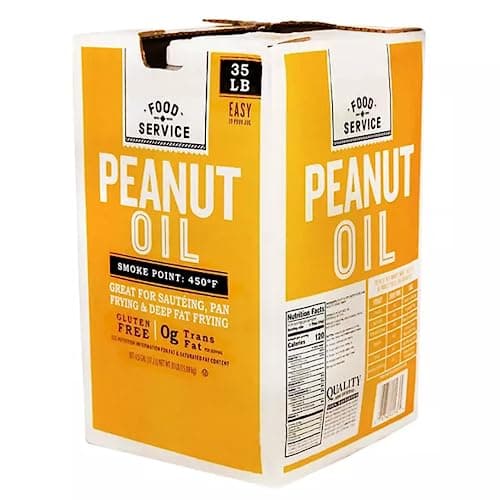 ANF Brands Pure Peanut Oil, 4.5 Gallon JugThree-gallon jugs map cleanly onto a 30-quart pot. | Buy this much | 9.3/10 | $104.99 · See the ANF peanut oil, 4.5 gal #ad We may earn a commission · Price as of November 18, 2026 |
| 2 | 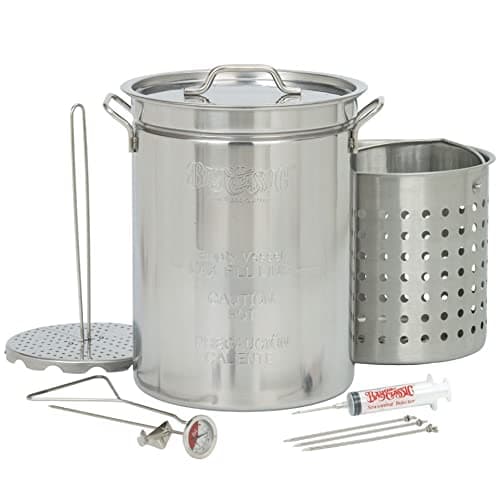 Bayou Classic 1118 32-qt Stainless Turkey Fryer PotA 32-quart stainless pot, the size that suits most birds. | The pot these numbers assume | 9.2/10 | $142.88 · See the Bayou Classic 1118 pot #ad We may earn a commission · Price as of November 18, 2026 |
| 3 | 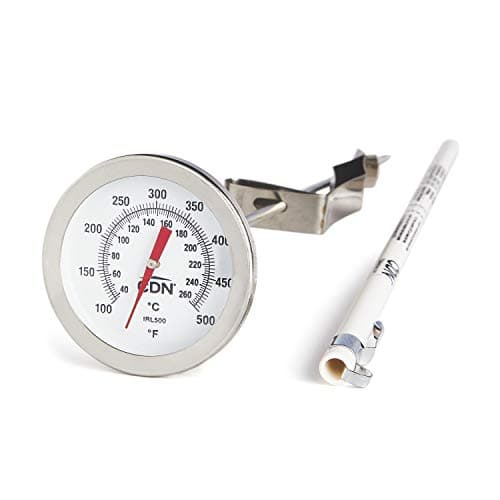 CDN Deep Fry Thermometer, 12 Inch Long StemVolume is half the job; the USDA asks for a thermometer in the oil the whole time. | The tool that watches the oil | 9.3/10 |
Scores are our own editorial rubric, explained on how we pick. Four criteria per category on a published 8.4-9.8 scale, so the leading pick is clear at a glance. A product scores the same here as it does on every other page of this site.
How the oil calculator works
The calculator above wants two numbers and gives you three: the gallons to buy, the bird weight that pot can actually take, and a reminder that the fill line itself comes from the water method below.
What it is doing. A turkey is close enough to water in density that its volume in quarts is roughly 0.48 times its weight in pounds. To get the one-to-two inches of cover the USDA asks for, the pot has to hold about three and a quarter times the bird’s own volume in bird-plus-oil — which works out at roughly a quarter of a gallon of oil per pound of turkey. Pot size does not change that number. It decides whether the combination fits at all, because you also need four to five inches of empty pot above the oil for the foam-up when the bird goes in.
What it is not doing. It cannot see your pot. Two 30-quart pots from different brands are different shapes, and a broad-breasted bird displaces more than a narrow one of the same weight. Treat the result as the shopping list and the water method as the fill line.
Why a chart is not enough
Two 30-quart pots from different brands are different shapes. A tall narrow pot and a wide shallow one hold the same volume and behave completely differently once a turkey displaces oil in them. The bird itself varies too — a 14-pound bird with a broad breast displaces more than a narrow one of the same weight.
So the chart tells you how much oil to buy. It does not tell you where to stop pouring. For that, you measure — and it takes five minutes.
The water method, step by step
This is the National Turkey Federation’s method, and the USDA describes the same test: “Place the turkey in the cooking utensil and add water to cover. Then remove the turkey and measure the amount of water. This is the amount of oil needed.”
Do all of this before you heat anything — cold pot, burner off, propane disconnected, no oil in the picture. Every step below involves water, and water meeting hot oil is the one thing this entire page exists to prevent. University of Illinois Extension puts it in five words: a mixture of water and oil can cause an explosion.
- Put the thawed turkey in the fryer basket and the basket in the empty pot.
- Fill with water until it sits one to two inches above the top of the bird.
- Lift the turkey out slowly and let it drain back in.
- Mark the water line on the inside of the pot — a strip of tape on the outside works, or note the distance down from the rim.
- Pour the water out.
- Dry the pot completely. Towel it, then leave it in the sun or over a very low flame until there is no moisture at all.
- Fill with oil to the mark.
Step six is not optional. Water trapped under hot oil is the exact mechanism behind a boil-over — the USDA’s own description is that water hitting frying oil “vaporizes instantaneously turning into super heated steam”. Illinois Extension says the same thing as an instruction: thoroughly dry the pot before filling it with oil.
One check while the tape is still on the pot: there should be at least four to five inches of bare pot above your mark. If there is not, that bird is too big for that pot, and the fix is a smaller bird or a bigger pot — never less oil, because then the turkey is not covered.
How much headroom you actually need
The one-to-two-inch rule above the bird matters at both ends. Too little oil and the top of the turkey is not submerged, so it cooks unevenly. Too much and the displacement pushes oil over the rim.
You also want four to five inches of empty pot above the oil line, because oil foams dramatically when a wet-surfaced bird enters it. If your marked line leaves less than that, use a smaller turkey or a bigger pot — do not simply pour less oil, or the bird will not be covered.
Our pot sizing guide works the same problem from the other direction.
Which oil, and the smoke point that matters
You are cooking at 350F. The oil’s smoke point is the temperature at which it stops behaving like oil and starts breaking down, so you want real headroom above 350F — not a margin of twenty degrees that a cold bird wipes out the moment it goes in.
University of Illinois Extension puts the frying group at about 450F: peanut, safflower and soybean (sold as vegetable oil). Canola and grapeseed sit slightly lower at 435 to 445F. For a turkey specifically, the same Extension service names peanut, corn, refined canola, rice and sunflower oil, and the National Turkey Federation lists the same set. The common thread is a high smoke point, not the plant it came from.
| Oil | Approximate smoke point | Frying a turkey in it? |
|---|---|---|
| Refined peanut | About 450F | Yes — the default, and the one that sells out first |
| Safflower | About 450F and up | Yes, if you can find it by the gallon |
| Soybean, sold as “vegetable oil” | About 450F | Yes — usually the cheapest workable option |
| High-oleic sunflower | High; named suitable for frying turkey | Yes — the nut-free answer |
| Refined canola | About 435-445F | Yes, with slightly less margin |
| Corn, rice bran | High; named suitable for frying turkey | Yes |
| Extra-virgin olive | About 320F | No — below your cooking temperature |
| Butter, coconut, unrefined oils | About 350F or lower | No |
Two practical notes on top of the numbers. Volume changes the shopping maths more than price per bottle does: at four gallons, a dollar a gallon is four dollars, so buy on smoke point and availability first. And whichever oil you choose, the USDA asks you to heat it to 350F and “monitor the temperature of the oil with a thermometer constantly during cooking” — which is a second instrument, not the dial on the lid. Our oil guide and thermometer picks go deeper on both.
The safety rules the volume depends on
Oil volume is not an isolated number. It is the one figure that decides whether hot oil stays in the pot, so the rest of the routine is part of the same answer.
- Thaw it completely. The USDA is explicit that a frozen or partly frozen bird must not be deep fried, and Illinois Extension asks for “a completely thawed bird”. Ice in the cavity is water, and water under hot oil flashes to steam. Our thawing timeline has the days you need.
- Dry the bird and the pot. Pat the turkey dry, inside and out, and dry the pot after the water measurement until there is no moisture left at all.
- Never overfill. Illinois Extension states the consequence plainly: if the pot is too full, oil can spill out the sides and result in burns or a fire. The USDA’s rule is a vessel large enough to submerge the bird without it spilling over, with the oil covering it by one to two inches.
- Outdoors, on a solid level surface. Illinois Extension: fryers should always be used outdoors on a solid even surface, well away from buildings and anything flammable. Never a garage, never a deck, never under an overhang.
- Keep a thermometer in the oil. Frying oil can exceed 400F. The USDA asks for constant monitoring, and if the oil starts smoking, the fryer goes off.
- Know the standards position before you buy. UL states that it does not certify any turkey fryers. NFPA’s Educational Messages Desk Reference goes further: it holds that oil turkey fryers as currently designed are “not suitable for safe use by even a well-informed and careful consumer”, and section 8.12.1 recommends using a fryer listed by a nationally recognised testing laboratory — an infrared, air or electric turkey fryer — and never leaving one unattended.
That last point is a real fork in the road, and worth taking seriously rather than reading past. If it lands, the oil-less fryers and indoor electric fryers are the listed appliances NFPA is pointing at, and an electric fryer uses under three gallons. If you are frying in oil outdoors anyway, read the full safety routine before Thanksgiving morning, not during it.
Buy one more gallon than the chart says
Running out of oil halfway through filling the pot on Thanksgiving morning, with every store crowded, is a genuinely bad twenty minutes. An extra unopened jug keeps for a year and costs less than the stress.
Peanut oil is also the item that vanishes from shelves in the week before the holiday. Buy it in early November. Which oil to buy is covered in our oil guide.
Buying the right volume also decides how much you have to deal with afterwards. When the bird is out, read can you reuse turkey fryer oil before you throw anything away, and how to dispose of turkey fryer oil for where it goes if it has turned.
Worth knowing before you buy the pot rather than after: oil scales with pot volume, not with the size of the bird, so an oversized pot is a standing order for extra oil every year you own it. That arithmetic, alongside what the propane and the electricity actually come to, is in what a turkey fryer costs to buy and to run.
The products, in detail
#ad We may earn a commission · Price as of November 18, 2026
#1 · Buy this much
ANF Brands Pure Peanut Oil, 4.5 Gallon Jug
Peanut oil is the default for a reason: a high smoke point and a flavour that does not fight the bird. One 4.5-gallon jug covers a 30-quart pot with margin.
- Volume
- 4.5 gallon jug
- Type
- Pure peanut oil
- Also
- Kosher certified
- Reuse
- Strain and refrigerate, 2-3 fries
Why we picked it
- 450F smoke point
- Neutral
- Reusable two or three times
Good to know
Costly at five gallons
Performance
9.6
Flavor
9.3
Value
8.4
Availability
9.0
#ad We may earn a commission · Price as of November 18, 2026
#2 · The pot these numbers assume
Bayou Classic 1118 32-qt Stainless Turkey Fryer Pot
The pot most serious outdoor rigs are built around — stainless, properly vented lid, and it ships with the basket and thermometer instead of making you buy them twice.
- Type
- Propane pot and accessories
- Capacity
- 32 qt
- Material
- Stainless steel
- Included
- Vented lid, poultry rack, thermometer, injector
Why we picked it
- Stainless
- Poultry rack and thermometer included
- Vented lid
Good to know
Pot only
Build quality
9.6
Ease of use
8.6
Capacity
9.2
Value
8.7
#3 · The tool that watches the oil
CDN Deep Fry Thermometer, 12 Inch Long Stem
A dial on a 12-inch stem that reads oil temperature continuously. The gauge built into a cheap kit is often the thing that is wrong.
- Range
- 100F to 500F
- Stem
- 12 in stainless
- Dial
- 1.75 in, glass lens
- Reads
- Oil, not meat
Why we picked it
- Reads 100F to 500F
- 12-inch stem clears the rim
- Clips on and stays put
Good to know
Reads oil, not meat
Accuracy
9.2
Build quality
8.9
Ease of use
9.3
Value
9.7
Frequently asked questions
Around 3 to 4 gallons with a 12-to-16 pound turkey in it. The pot itself would hold more, but the bird displaces oil and you need headroom for foaming. Measure with water to get your exact line.
About 2.75 gallons for the indoor electric XL — roughly a third of what a large propane pot wants. Confirm with the water method before pouring.
The bird displaces it over the rim. Outdoors that means oil onto an open flame, which is the single most common cause of turkey fryer fires. It is precisely what the water method prevents.
You can use the chart as an approximation, but the water method takes five minutes and removes the guesswork entirely. Given what being wrong costs, there is no good reason to skip it.
About 3 to 3.5 gallons with a 12-to-14 pound bird in it. A 28-quart pot takes roughly a 14-pound turkey at most once you leave the four to five inches of empty pot the foam-up needs, so it is the size to match to a smaller bird rather than stretch to a large one.
Around 5 gallons for an 18-to-20 pound turkey, which is the bird size a 40-quart pot is built around. The pot would physically hold more oil than that, but the bird displaces it and the headroom is not negotiable.
No, and it says so every time it answers. The calculator tells you how many gallons to buy; the water method tells you where to stop pouring on the day. Pot shapes differ at the same rated capacity, so only the measurement in your own pot gives a real fill line — and it has to be done cold, before any heat or oil.
Peanut, safflower and soybean (vegetable) oil sit at about 450F per University of Illinois Extension, with canola slightly lower at 435 to 445F. You are cooking at 350F and want real headroom, so skip extra-virgin olive oil at about 320F and anything unrefined.
Our recommendation
If you only take one thing from this page: buy the ANF peanut oil, 4.5 gal. If that is not the right fit for your setup, the Bayou Classic 1118 pot is the one to get instead.
Buy this much
9.3/10ANF Brands Pure Peanut Oil, 4.5 Gallon Jug
Three-gallon jugs map cleanly onto a 30-quart pot.
#ad We may earn a commission · Price as of November 18, 2026
Runner-up — The pot these numbers assume
9.2/10Bayou Classic 1118 32-qt Stainless Turkey Fryer Pot
A 32-quart stainless pot, the size that suits most birds.
#ad We may earn a commission · Price as of November 18, 2026
Brands: want your product tested? For Brands.
Sources
- USDA Food Safety and Inspection Service — Deep Fat Frying and Food Safety
- University of Illinois Extension — Fried Turkey
- University of Illinois Extension — Are Oils Interchangeable? (smoke points)
- NFPA — Educational Messages Desk Reference, 2026 edition, section 8.12 (Turkey Fryers)
- UL — Put Safety on the Menu This Thanksgiving (UL does not certify turkey fryers)
- National Turkey Federation — How to Deep Fry a Turkey (eatturkey.org)
- State Farm — Turkey fryer safety tips
Related reading
- The Best Turkey Fryers of 2026Six fryers, ranked for someone doing this for the first time. Indoor electric wins, and we explain exactly why.
- The Best Oil for Frying a TurkeyPeanut oil, the nut-free alternative, and the thermometer that stops you ruining either one.
- The Best Turkey Fryer ThermometersLong-stem oil thermometers that clip to the pot rim, plus the instant-read probe for the bird, and why you need both.
- Turkey Fryer Safety: How to Do This Without IncidentTen ordered safety steps from published fire-safety and turkey-industry guidance, plus the gear that backs them up.
- What Size Turkey Fryer Do I Need?Pot size to bird weight, in one table — plus the guest-count math that tells you which bird to buy in the first place.
- How to Deep Fry a TurkeyThe whole process in order, with the numbers sourced — thaw, measure, heat to 350F, cook to 165F, rest.
- The Best Turkey Fryer PotsFour pots and baskets ranked on oil economy, whether the rack and hook are included, and how long stainless lasts against aluminum.