How to Smoke a Turkey on a Pellet Grill
Frying is fast and smoking is slow, and on Thanksgiving slow is the one that leaves your hands free. Here is the USDA version of how it is done, the times by weight, and the gear that holds the temperature so you do not have to.
By Mike M. · Published · Last updated
How this page is funded: Fryer & Feast is a participant in the Amazon Associates Program, and in brand partner programs run through the Impact network — currently Pit Boss, which sells direct. If you buy through a link here we may earn a commission, at no extra cost to you. It never changes which products we recommend — see how we pick and our full affiliate disclosure. Every buy link goes straight to the retailer, so the price you see is the live one on the day you buy.
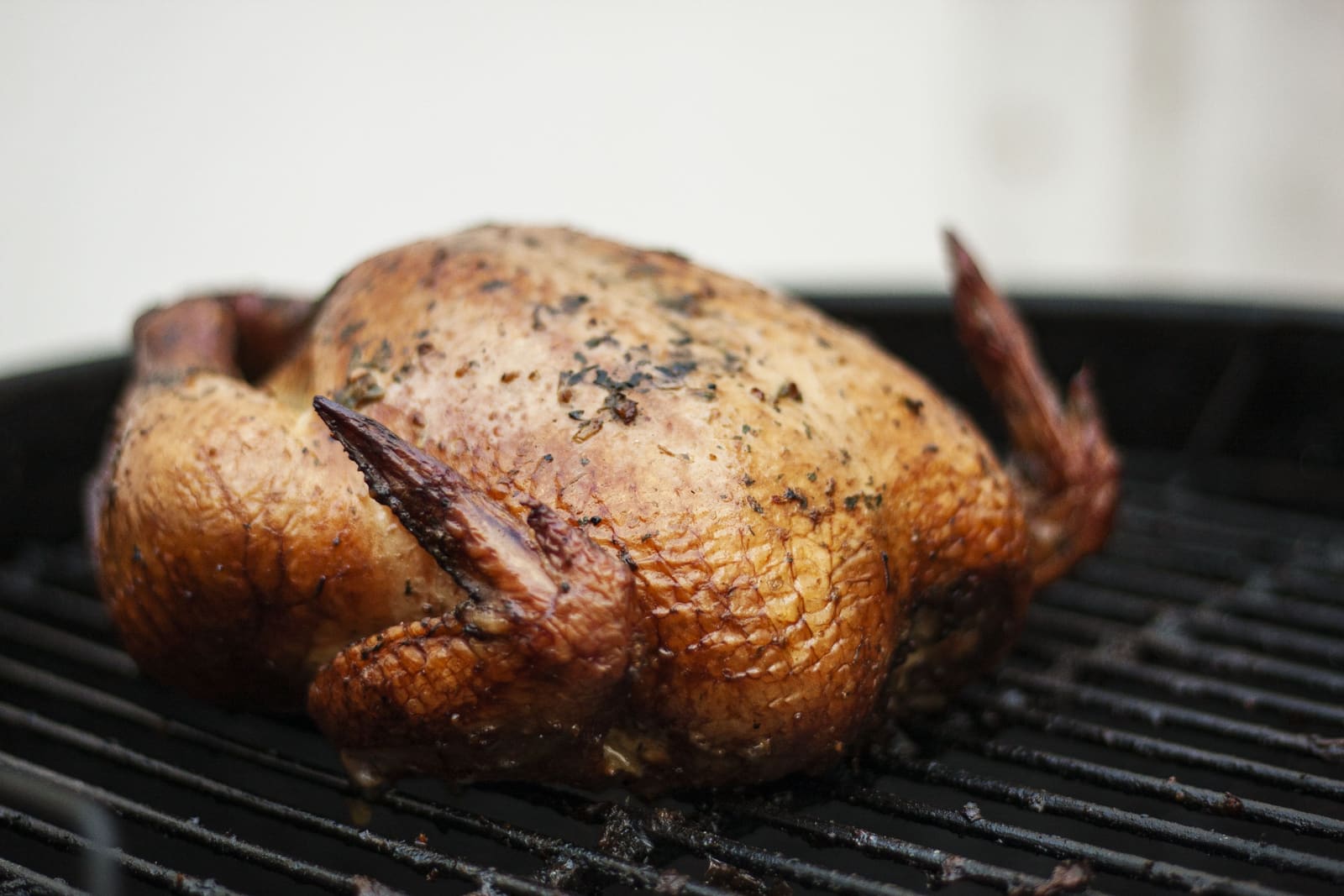
The short version. Thaw the turkey completely, do not stuff it, and run the smoker so the air inside stays between 225 and 300 °F. Allow 20 to 30 minutes per pound for an 8 to 12 pound bird, put a drip pan of water underneath, and take it off when a food thermometer reads 165 °F in the innermost part of the thigh and wing and the thickest part of the breast. Let it stand 20 minutes before carving. Those are USDA’s numbers, not ours.
On a pellet grill the only real difference from any other smoker is that a controller and an auger hold that temperature band for you. You set 250 °F, the grill feeds itself hardwood pellets, and you spend the afternoon on the eight other things rather than on a charcoal pan. That is the whole argument for doing it this way on the one day of the year when your attention is the scarce thing.
Why smoke it instead of frying it
We are a site that mostly writes about turkey fryers, so take this as an honest comparison rather than a conversion pitch. The two methods solve different problems.
- Frying is fast and loud. USDA puts deep frying at 3 to 5 minutes per pound, so a 12 lb bird is done in under an hour — but it is an hour of standing over five gallons of 350 °F oil, and the safety rules are not optional. If you want that route, the step-by-step fry guide is the one to read.
- Smoking is slow and quiet. Four or five hours instead of one, outdoors, with the oven free the entire time for sides. That last point is the one first-time hosts underrate: the oven is the bottleneck on Thanksgiving, not the turkey.
- The flavour is genuinely different. Hardwood smoke goes all the way through the breast rather than sitting on the skin, which is the one thing neither frying nor roasting does.
- The size ceiling is lower. USDA publishes smoking times for 8 to 12 pound birds only. If you are feeding twenty, read the size-ceiling section below before you commit.
If you have not settled on a method at all yet, the best way to cook a turkey guide puts all five side by side.
The six USDA rules that actually matter
Smoking is the cooking method where food safety advice stops being box-ticking, because the whole technique is built on holding meat at a low temperature for a long time. Every rule below is published by the USDA Food Safety and Inspection Service and linked in the sources at the bottom of this page.
- Thaw it completely first. Never smoke a frozen or part-frozen turkey. USDA is explicit that smoking is too slow to thaw the bird safely — it would sit in the 40 to 140 °F Danger Zone for hours. Allow about 24 hours of refrigerator thawing for every 4 to 5 pounds, which is 3 to 4 days for a 12-pounder. Full timings: how to thaw a turkey.
- Hold the air at 225 to 300 °F. Not lower. The whole cook has to stay inside that band, and USDA asks for a thermometer watching the smoker air, not just the meat.
- Do not stuff it. At smoking temperatures the stuffing takes too long to reach 165 °F. Cook it in a casserole dish indoors.
- Use two thermometers. One for the smoker air, one for the meat. Most pellet grills have the first built in and ship with a probe for the second; a good instant-read is still worth having to spot-check the result.
- Use a drip pan with water in it. USDA calls for one under the bird. It catches the fat so it cannot flare, and the steam helps the cook along.
- 165 °F, in three places. Innermost thigh, innermost wing, thickest part of the breast. Then refrigerate the leftovers within two hours of the bird coming off the smoker, in shallow containers, and use them within four days.
If a sauce or glaze is going on, USDA says put it on in the last 15 to 30 minutes. Any earlier and the sugar in it burns over a four-hour cook.
Timing by weight
USDA publishes one smoking figure: 20 to 30 minutes per pound, for a turkey between 8 and 12 pounds, with the smoker air held at 225 to 300 °F. The table below is that figure applied to each weight and nothing else — the spread is wide because the real time moves with the outside air temperature, the wind, and every time the lid comes up.
| Turkey weight | At 30 min/lb (allow this much) | At 20 min/lb (earliest it may be ready) |
|---|---|---|
| 8 lb | 4 hr | 2 hr 40 min |
| 9 lb | 4 hr 30 min | 3 hr |
| 10 lb | 5 hr | 3 hr 20 min |
| 11 lb | 5 hr 30 min | 3 hr 40 min |
| 12 lb | 6 hr | 4 hr |
| Over 12 lb | USDA publishes no smoking time above 12 lb. See the next section. | |
Plan the day against the long column and be pleased if it finishes early — a turkey that is ready an hour ahead can rest, or be held warm safely, while a turkey that is an hour late cannot be hurried. If you are fitting this around everything else, the cooking timeline works backwards from when you want to eat.
What to do if your bird is bigger than 12 pounds
This is the part most smoking guides skip. USDA’s smoking chart covers 8 to 12 pounds and stops. There is no official 18-pound smoking time to quote, so we will not make one up. Three honest options:
- Smoke two small birds. Two 10-pounders feed more people than one 18-pounder and cook in the time the chart actually covers. It is why the bigger cabinets below exist.
- Use the covered-grill numbers instead. USDA does publish a covered charcoal or gas grill method for 8 to 16 pound birds at 15 to 18 minutes per pound, same 225 to 300 °F air and same drip pan. On a pellet grill that means running nearer the top of the band.
- Cook the big one indoors. An oven or an electric roaster oven has published times all the way to 24 pounds. Smoke a turkey breast alongside it if you want the flavour on the table.
The method, start to finish
- Three to four days out: start thawing in the refrigerator, 24 hours per 4 to 5 pounds, in a container that catches drips.
- The night before: if you are brining, do it now — our brining guide covers both kinds. Buy the pellets at the same time. A long cook goes through more than people expect, and running out at hour three is the classic failure.
- Two hours before lighting: take the bird out of any brine, rinse if the recipe says to, and get the skin as dry as you can. Dry skin is the only thing that browns. Leave the cavity empty.
- Light the grill and let it settle. Set 250 °F and give it fifteen minutes to stabilise before the bird goes on. Put a foil pan of water on the grate or rack below where the turkey will sit.
- Bird on, breast up, lid down. Put the probe into the thickest part of the breast without touching bone. Then leave it alone — every lid lift costs heat and pushes the finish time out.
- Check at the three-quarter mark. Use the long column of the table above. If the breast is browning much faster than the thigh is climbing, tent that part loosely with foil.
- Finish hot if your grill can. A barrel-style pellet grill that reaches 450 to 500 °F can spend the last 15 to 20 minutes there to tighten the skin. A vertical cabinet that tops out at 420 °F cannot do much about rubbery skin, so finish the bird in a hot kitchen oven for ten minutes instead. Glaze, if you are using one, goes on in the last 15 to 30 minutes either way.
- Pull at 165 °F in the innermost thigh, the innermost wing and the thickest part of the breast. Rest it 20 minutes before carving, then get the leftovers into the refrigerator within two hours of it leaving the smoker.
The gear: Pit Boss pellet grills and vertical smokers
Pit Boss is the brand we point at for this because the entry price for a controller-driven pellet grill is lower than anything comparable and the whole line uses the same hopper-and-auger system, so the cheap one runs the same way as the expensive one. These four are ranked for one job — getting a whole bird through a Thanksgiving afternoon safely — which is why a $379.99 barrel grill outranks a $649.99 cabinet here. The barrels reach 500 °F and the cabinets stop at 420 °F, and that last half hour of heat is the difference between crisp skin and rubber.
Prices below are Pit Boss’s own list prices, read off their store on 13 November 2026, and every spec came from the same product page. None of these four carried a discount on that date, so none is shown. We have not cooked on them: the ranking is a spec-and-price judgment against USDA’s requirements, and our rubric is on how we pick.

1. Best overall for one turkey
Pit Boss Carbon Series 700 Wood Pellet Grill (PB700CP)
The cheapest unit here that does both halves of the job: it holds the low temperature USDA asks for and it still climbs to 500F, which is the part that fixes the skin. 718 square inches is enough grate for a bird and a tray of sides afterwards.
- Cooking area:
- 718 sq in
- Temperature:
- 180F to 500F, digital LCD controller
- Hopper:
- 13.5 lb, with cleanout
- Included:
- Meat probe, 3-year warranty
The catch: The 13.5 lb hopper is the smallest here. A 20-to-30-minute-per-pound smoke plus a hot finish will want watching and topping up, not leaving alone for six hours.
$379.99 — Pit Boss list price as of 13 November 2026. Check the button for today’s.

2. Best if the turkey is not the only thing cooking
Pit Boss FB2 Series 850 Wood Pellet Grill (PB850FB2)
840 square inches on two tiers, a 21 lb hopper and the same 180F-to-500F range, so the bird can sit on the main grate while everything that wants reheating sits above it. The longer hopper is the real upgrade over the Carbon 700, not the extra grate.
- Cooking area:
- 840 sq in, 2 tiers
- Temperature:
- 180F to 500F, 5F increments
- Hopper:
- 21 lb
- Included:
- 1 meat probe (2 ports), 5-year warranty
The catch: The Flame Broiler lever opens a direct flame up to 1,000F. That is for searing steak, not for a turkey — a bird over an open flame chars outside long before 165F reaches the thigh.
$599.99 — Pit Boss list price as of 13 November 2026. Check the button for today’s.

3. Best for the long, unattended smoke
Pit Boss Navigator 3-Series Wood Pellet Vertical Smoker (PBV3M)
A cabinet, not a barrel: 1,118 square inches over five racks and a 50 lb hopper, which is the one here you can genuinely set at 250F and leave. Three probe ports and a window mean the door stays shut, and the door staying shut is most of the battle.
- Cooking area:
- 1,118 sq in, 5 racks
- Temperature:
- 130F to 420F, digital control
- Hopper:
- 50 lb
- Connectivity:
- Wi-Fi and Bluetooth, 3 probe ports
The catch: 420F is the ceiling. That is comfortably inside the USDA smoking range but short of the 500F a barrel grill uses to tighten the skin at the end, so plan on finishing the bird in the kitchen oven if crisp skin matters to you.
$649.99 — Pit Boss list price as of 13 November 2026. Check the button for today’s.

4. Best for two birds, or a bird and a brisket
Pit Boss Sportsman 5-Series Wood Pellet Vertical Smoker (PBV5P2)
1,679 square inches across six adjustable racks for the same money as the Navigator 3-Series, which is the answer when USDA's own smoking chart stops at 12 lb and you are feeding sixteen people. Pull two racks and two small turkeys go in side by side.
- Cooking area:
- 1,679 sq in, 6 adjustable racks
- Racks:
- Porcelain-coated, adjustable
- Control:
- App-connected control board
- Build:
- Powder-coated, 4 locking caster wheels
The catch: Pit Boss publishes neither a temperature range nor a hopper capacity for this one, so we quote neither, and that missing detail is why it ranks below the Navigator at the same price. It is also 140 lb on casters — a garage appliance, not something you move onto a balcony for the day.
$649.99 — Pit Boss list price as of 13 November 2026. Check the button for today’s.
Two things none of them include. Hardwood pellets are sold separately by every brand, and a long smoke eats more of them than a weeknight cook — buy two bags. And a second thermometer, because USDA wants one on the air and one in the meat, and the probe in the box only does the second job.
If none of this is your budget this year, the cheapest Pit Boss we cover is the Carbon Series 500, and it sits on the best way to cook a turkey page with the other four methods.
The four things that go wrong
- Rubbery skin. The commonest complaint, and it is physics rather than a mistake: skin needs high heat to crisp and smoking is low heat by definition. Dry the skin properly beforehand and finish hot, on the grill if it reaches 450 °F or in the kitchen oven if it does not.
- Running out of pellets. The hopper figure in each spec list is the number to look at if you are not going to be standing next to it. 13.5 lb is a watchful afternoon; 50 lb is not.
- Opening the lid. Every look costs heat, and heat lost at hour two moves dinner at hour five. This is what the probe ports and the window on the cabinet models are for.
- Treating pink as raw. Smoke leaves a pink ring near the surface of poultry permanently. The thermometer is the test, in all three places, every time.
Frequently asked questions
USDA is specific about this one: the air in the smoker must stay between 225 and 300 °F for the whole cook, and you need a thermometer watching that air temperature as well as one in the bird. On a pellet grill, set the controller to 250 °F and it sits in the middle of that band on its own.
Estimate 20 to 30 minutes per pound at 225 to 300 °F, which is USDA’s figure for an 8 to 12 pound bird — so roughly 3 to 5 hours for a 10-pounder. USDA also notes that smoking in general can take anywhere from 4 to 8 hours, and that the time moves with the weather and how often you open the lid. The clock is a planning tool. The thermometer is the answer.
165 °F, measured in the innermost part of the thigh and wing and the thickest part of the breast. That is the same safe minimum internal temperature as a roast turkey — smoking changes the route, not the destination. Colour is not a test: smoke turns poultry pink near the surface, and a perfectly safe smoked bird often looks underdone.
No. USDA says plainly: do not stuff a smoked turkey, because smoking cooks at a low temperature and the stuffing can take too long to reach 165 °F — and smoked stuffing tastes bad anyway. Cook the stuffing in a casserole in the kitchen oven instead.
USDA’s smoking chart only covers 8 to 12 pounds, so there is no published smoking time for a 20-pounder and we are not going to invent one. The two safe answers are to smoke two smaller birds, or to use the covered-grill method USDA does publish for 8 to 16 pounds at 15 to 18 minutes per pound. If you want one big bird on the table, an electric roaster oven or the regular oven is the method with real numbers behind it. Work out the weight you actually need first with how much turkey per person.
Any smoker that holds 225 to 300 °F will do it. A pellet grill’s advantage on Thanksgiving is that the controller holds that band for you instead of asking you to add charcoal every hour, which matters on the one day of the year you also have eight other things on. The trade-off is that it needs mains power and a bag of hardwood pellets, neither of which a charcoal smoker cares about.
If a food thermometer reads 165 °F in the thigh, the wing and the thickest part of the breast, it is cooked, pink or not. Smoke reacts with the meat near the surface and leaves a pink ring that no amount of extra cooking removes — which is why USDA’s guidance is a temperature and not a colour.
Where to go next
- The best way to cook a turkey — smoking against frying, roasting, the roaster oven and the grill, with the case for each.
- The best meat thermometers — the one piece of kit this entire page depends on.
- How to thaw a turkey — the three safe methods and how long each one really takes.
- The first-Thanksgiving starter kit — what a first-time host actually needs, and what to skip.
- The holiday gift guide — including this gear, for anyone buying for the person who cooks.
Sources
- USDA FSIS — Turkey: Alternate Routes to the Table (smoking a turkey: 8 to 12 lb, 20 to 30 minutes per pound, do not stuff, smoker air 225 to 300 °F, use a drip pan)
- USDA FSIS — Smoking Meat and Poultry (two thermometers, 225 to 300 °F air temperature, 4 to 8 hours, poultry to 165 °F, sauce in the last 15 to 30 minutes, refrigerate within 2 hours)
- USDA FSIS — Turkey Basics: Safe Cooking (165 °F in the innermost thigh and wing and the thickest part of the breast; stand 20 minutes before carving)
- USDA FSIS — Turkey Basics: Safe Thawing (24 hours per 4 to 5 pounds in the refrigerator; 30 minutes per pound in cold water)
- USDA FSIS — Danger Zone, 40 °F to 140 °F
- Pit Boss — Carbon Series 700 Wood Pellet Grill (PB700CP): 718 sq in, 180 to 500 °F, 13.5 lb hopper
- Pit Boss — FB2 Series 850 Wood Pellet Grill (PB850FB2): 840 sq in, 180 to 500 °F, 21 lb hopper
- Pit Boss — Navigator 3-Series Vertical Pellet Smoker (PBV3M): 1,118 sq in, 130 to 420 °F, 50 lb hopper
- Pit Boss — Sportsman 5-Series Vertical Smoker (PBV5P2): 1,679 sq in, six adjustable racks