Roaster Oven Cooking Times and Temperatures
The per-pound numbers come straight from the manufacturer's own roasting instructions — and then the thermometer overrules all of them.
By Mike M. · Published · Last updated
How this page is funded: Fryer & Feast is a participant in the Amazon Associates Program. If you buy through a link here we may earn a commission, at no extra cost to you. It never changes which products we recommend — see how we pick and our full affiliate disclosure. Every buy link goes straight to the retailer, so the price you see is the live one on the day you buy.
Turkey: preheat the roaster to 400°F, roast for one hour at 400°F, then reduce to 350°F for the rest of the time, allowing 15 to 20 minutes per pound in total and adding 30 to 45 minutes if the bird is stuffed. Ham: 325°F, 15 to 20 minutes per pound, to an internal 160°F. An 18-quart roaster takes a bird up to 22 pounds; a 12-quart tops out at 14 pounds, with the same minutes per pound.
Those are Nesco’s published figures for its own roaster ovens, and they are the right starting point for any similar unit. Everything below is the chart in full, plus the four things that move a real bird off the chart.
Quick picks
| # | Product | Best for | Score | Price |
|---|---|---|---|---|
| 1 | No image Nesco 18-Quart Roaster OvenNesco publishes per-pound times and temperatures for its own roasters, which is why a first attempt in one goes smoothly. | The unit these numbers come from | 9.3 | |
| 2 | 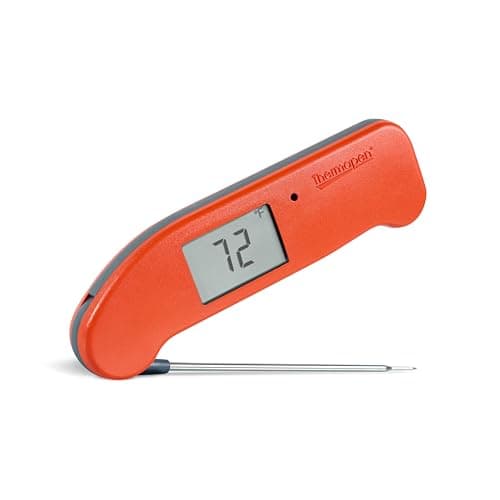 ThermoWorks Thermapen ONE Instant-Read ThermometerEvery per-pound figure on this page is an estimate until an instant-read probe confirms it. | The number that overrules the chart | 9.4 | $125.00 · View on Amazon #ad We may earn a commission · Price as of October 10, 2026 |
| 3 | 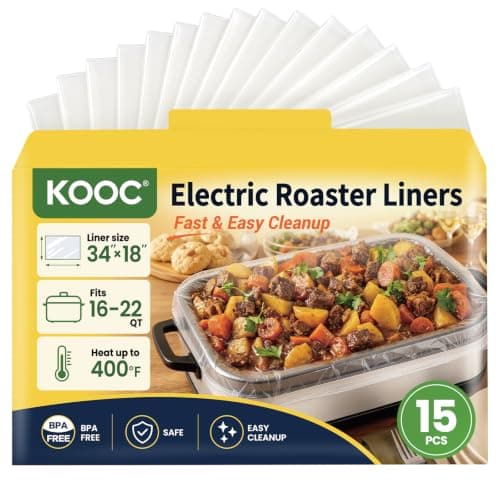 KOOC Electric Roaster Liners, 15 CountThree hours of drippings and glaze baked onto an enamel cookwell is the worst dish of the day. | What makes the chart survivable | 9.0 | $14.99 · View on Amazon #ad We may earn a commission · Price as of October 10, 2026 |
Scores are our own editorial rubric, explained on how we pick. Four criteria per category, scored out of ten, so the leading pick is clear at a glance.
Turkey: the chart
The published method is a two-stage roast: preheat the roaster to 400°F, give the bird one hour at 400°F, then drop the dial to 350°F for the remainder. Total time is normally 15 to 20 minutes per pound, and a stuffed bird adds 30 to 45 minutes.
- 12 lb — about 3 to 4 hours total.
- 14 lb — about 3 hours 30 minutes to 4 hours 40 minutes. This is the ceiling for a 12-quart roaster.
- 16 lb — about 4 to 5 hours 20 minutes.
- 18 lb — about 4 hours 30 minutes to 6 hours.
- 20 lb — about 5 to 6 hours 40 minutes.
- 22 lb — about 5 hours 30 minutes to 7 hours 20 minutes. This is the ceiling for an 18-quart roaster.
Each of those is arithmetic on the published 15-to-20-minutes-per-pound figure, not an independent claim, and the spread between the two ends of each range is why you start earlier than you think you need to. Finish on temperature: the thickest part of the thigh muscle at 180°F.
If your bird is heavier than your pan’s rating, no amount of extra time fixes it. See what size roaster oven you need.
Ham: the chart
A precooked ham is a different job — you are warming it through rather than cooking it — and the published figure is 325°F, 15 to 20 minutes per pound, to an internal 160°F, with glaze applied during the final 30 minutes.
- 6 lb half ham — about 1 hour 30 minutes to 2 hours.
- 8 lb — about 2 to 2 hours 40 minutes.
- 10 lb — about 2 hours 30 minutes to 3 hours 20 minutes.
- 12 lb bone-in — about 3 to 4 hours.
Lid on for the bulk of the time, lid off for the glaze. The full method, and which roaster suits a ham best, is in roaster ovens for a ham.
The four things that move a real bird off the chart
Minutes per pound assumes a set of conditions that your kitchen will not quite match. These are the four variables that account for most of the difference.
- Starting temperature. A bird straight out of a cold refrigerator takes meaningfully longer than one that has sat out for the half hour most recipes assume. This is the single biggest cause of a turkey running late.
- Stuffing. Add 30 to 45 minutes for a stuffed bird, and the stuffing itself has to reach a safe temperature, which is slower than the meat around it.
- Opening the lid. Every time you lift it, the trapped heat and steam leave and the pan has to recover. A self-basting lid exists so you do not need to; use it that way and check once, late.
- Preheating, or not. The per-pound figure starts when the roaster is already at temperature. Putting a bird into a cold pan and starting the clock costs you the preheat twice.
Plan backwards from when people sit down, use the slow end of the range, and build in a buffer. A bird that finishes early is a solved problem if you can hold it warm — a bird that finishes late is not a problem you can solve at all. Our cooking timeline lays the whole day out hour by hour.
After the chart runs out: holding it safely
A roaster oven is unusual among cooking appliances in that it is also a decent holding cabinet, and on a day when nobody sits down on time that is worth more than speed. Food has to stay at or above 140°F, and the 40°F-to-140°F range is the one to stay out of. Two hours at room temperature is the limit.
So: bird out at temperature, tented and resting on a board. Sides into the roaster, dial at its lowest setting, lid on. A unit whose dial reaches 125°F does this gently; one that starts at 150°F holds safely but keeps cooking. Either beats leaving bowls on a counter.
For dedicated holding gear rather than borrowing the roaster, see how to keep food warm for a party.
One last step the chart does not include
Follow every number on this page and you will get a turkey that is correctly cooked, moist, and pale. A covered roaster traps steam by design — that is why the breast stays juicy and why the skin never crisps.
Budget ten to fifteen minutes under your wall oven’s broiler at the end, after the bird has hit temperature, and watch it the whole time. That is the step that makes a roaster-oven turkey look like an oven turkey. Technique in how to use a roaster oven, and the broader trade-off in roaster oven versus your oven.
The products, in detail
#1 · The unit these numbers come from
Nesco 18-Quart Roaster Oven
Heat wraps the cookwell rather than sitting under it, which is why it browns more evenly than the price suggests. Eighteen quarts still swallows a 22-pound turkey.
- Capacity
- 18 qt
- Max bird
- Up to 22 lb
- Element
- Wrap-around, 1,450 W
- Cookwell
- Removable
What’s good
- Manufacturer-published roasting instructions rather than guesswork
- Takes a bird up to 22 lb in 18 qt
- Wrap-around 1,450 W element browns the cookwell sides, not just the base
- Removable cookwell for cleanup
What’s not
- 22 lb is a hard ceiling — a 26 lb bird needs a bigger pan
- Soft skin unless you finish under a broiler
- Still a large box to store for one or two days of use
Predictability
9.6
Heat evenness
9.4
Capacity
8.8
Value
9.4
#ad We may earn a commission · Price as of October 10, 2026
#2 · The number that overrules the chart
ThermoWorks Thermapen ONE Instant-Read Thermometer
One-second reads and the accuracy everyone else is measured against. If you buy one thing off this whole site, buy an accurate thermometer.
Minutes per pound is a planning tool, not a doneness test. A roaster oven’s own dial reads the air inside the pan, the lid gets opened, the bird starts at whatever temperature your refrigerator left it, and all of that shifts the real finish time by half an hour in either direction.
Nesco’s own instruction is to roast until the thickest part of the thigh muscle reaches 180°F on a meat thermometer, and that sentence is the one that matters. Use the chart to decide when to start; use the probe to decide when to stop. Placement matters as much as the tool — see the probe placement guide.
- Type
- Instant-read probe
- Read time
- About 1 second
- Accuracy
- Within about 0.5F
- Use
- Meat and oil spot checks
What’s good
- One-second reads, so you check the thigh without holding the lid open
- Spot-check several places in the bird rather than trusting one reading
- The only way to know a roaster oven has actually finished the job
- Works on ham, roasts and reheated leftovers just as well
What’s not
- Instant-read, not leave-in — you open the lid to use it
- Premium price for a single-function tool
- Easy to lose in a busy kitchen
Accuracy
9.8
Speed
9.8
Build
9.4
Value
8.4
#ad We may earn a commission · Price as of October 10, 2026
#3 · What makes the chart survivable
KOOC Electric Roaster Liners, 15 Count
Not essential, genuinely useful. A liner turns the worst cleanup of the day into lifting a bag out of a pan, which matters when the kitchen is already full of dishes.
- Fits
- 16-22 qt, 18 x 34 in
- Pack
- 15 liners
- Material
- BPA-free nylon blend
- Rated
- To 400F
What’s good
- Turns the cookwell cleanup into lifting a bag out
- Fits 16-22 qt pans, 18 x 34 in
- Rated to 400F, which covers the whole roasting sequence
- 15 to a pack, so it is not a once-only purchase
What’s not
- 400F rating means they are not for the broiler step
- Not essential — a removable cookwell washes fine with effort
- A torn liner is worse than no liner
Usefulness
9.0
Fit
9.0
Heat rating
8.6
Value
9.4
Frequently asked questions
Normally 15 to 20 minutes per pound. The published method is to preheat to 400°F, roast for one hour at 400°F, then reduce to 350°F for the remaining time. A 16-pound bird therefore runs roughly four to five and a half hours, and a stuffed bird adds 30 to 45 minutes.
400°F to start, for the first hour, then 350°F for the rest of the cooking time. Finish on temperature rather than the clock: the thickest part of the thigh muscle should read 180°F on a meat thermometer.
Up to 22 pounds. A 12-quart roaster is recommended for a maximum of 14 pounds, and the minutes-per-pound figure is the same for both. If your bird is over the pan’s rating, extra time does not fix it — you need a larger pan.
Yes — 30 to 45 minutes on top of the per-pound total. The stuffing also has to come up to a safe temperature in its own right, and it heats more slowly than the meat around it, so check it separately with a probe.
Treat it as a setting, not a measurement. The dial governs the air temperature in the pan, which is not the same as the temperature of the food, and it does not know that you opened the lid twice. An instant-read probe in the thigh is the number that decides when the bird is done.
Because the lid traps steam, which is exactly what keeps the meat moist. Nothing in the timing fixes it. Once the bird is up to temperature, give it ten to fifteen minutes under your wall oven’s broiler and watch it closely.
Sources
Related reading
- How to Use a Roaster OvenThe whole method from preheat to holding the sides warm afterward, with times by weight.
- What Size Roaster Oven Do I Need?Roaster capacity to bird weight to guest count, in one table — plus when 28 quarts is genuinely too much.
- The Best Roaster Ovens for a HamWhy a ham wants a low dial rather than a big pan, the 325F / 15-20 minutes per pound numbers, and three roasters that suit the job.
- The Best Electric Roaster Ovens of 2026Five roaster ovens ranked, plus the two accessories that make the difference. No oil, no flame, and your oven stays free.
- Where to Put a Meat Thermometer in a TurkeyExact probe placement, the target temperature, and why the pop-up timer should be ignored.
- A Thanksgiving Cooking Timeline That Fits One OvenBackwards from dinner: what to make two days ahead, the oven schedule, the last hour, and how to hold everything at 140F while the table fills up.