The Best Roaster Ovens for a Ham
A ham is already cooked, which changes everything: you are reheating gently to 160F and glazing at the end, not chasing a doneness temperature.
By Mike M. · Published · Last updated
How this page is funded: Fryer & Feast is a participant in the Amazon Associates Program. If you buy through a link here we may earn a commission, at no extra cost to you. It never changes which products we recommend — see how we pick and our full affiliate disclosure. Every buy link goes straight to the retailer, so the price you see is the live one on the day you buy.
For a ham, the Nesco 18-quart is the pick: a ham is far shorter than a turkey so you do not need 22 quarts, the wrap-around element heats the sides where a ham actually sits, and Nesco publishes the numbers — preheat to 325°F and allow 15 to 20 minutes per pound, to an internal 160°F for a precooked ham.
Take the Hamilton Beach 32215 instead if you are doing a ham and something else and want the 125°F hold, or the Oster 22-quart if a very large bone-in ham is going in alongside vegetables. But the default is the smaller unit, and that is unusual enough on this site to be worth explaining.
Quick picks
| # | Product | Best for | Score | Price |
|---|---|---|---|---|
| 1 | No image Nesco 18-Quart Roaster OvenA ham does not need the extra four quarts, and the wrap-around element heats where a ham sits. | Best overall for a ham | 9.4 | |
| 2 | 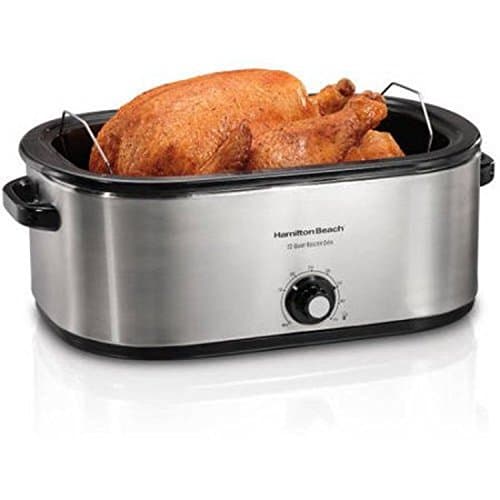 Hamilton Beach 32215 22-Quart Roaster OvenThe 125F floor means the ham can sit at serving temperature for as long as it takes everyone to arrive. | Best if the ham shares the day | 9.0 | $199.99 · View on Amazon #ad We may earn a commission · Price as of October 10, 2026 |
| 3 | No image Oster 22-Quart Roaster Oven with Self-Basting LidTwenty-two quarts and a removable enamel insert — room for the joint and a tray of roots underneath it. | Best for a big bone-in ham plus sides | 8.9 |
Scores are our own editorial rubric, explained on how we pick. Four criteria per category, scored out of ten, so the leading pick is clear at a glance.
Why a ham changes the shopping list
Almost every roaster-oven buying guide, including ours, is written around a turkey, and a turkey is a tall, awkward, raw bird you are trying to cook through without drying the breast. A ham is none of those things. It is usually fully cooked already, it is short and dense, and the objective is to warm it evenly and put a glaze on it.
Three consequences. First, capacity stops being the headline number — the vertical clearance a 22-quart pan buys you is clearance a ham does not use. Second, heat evenness matters more, because a dense cylinder warms from the outside in and you do not want the outside leathery before the center arrives. Third, the bottom of the temperature dial becomes genuinely useful, because a ham is the dish most likely to be ready before anyone is hungry.
That is why the ranking on this page is not the same as the ranking on our general roaster oven roundup. Different food, different winner.
The temperature and the timing
Nesco publishes its own instruction for a precooked ham in a roaster oven, and it is the number to work from rather than anything improvised: preheat the roaster to 325°F, allow 15 to 20 minutes per pound, and take it to an internal temperature of 160°F, basting or glazing during the last 30 minutes.
What that works out to in practice:
- 6 lb half ham — roughly 1 hour 30 minutes to 2 hours at 325°F.
- 8 lb ham — roughly 2 to 2 hours 40 minutes.
- 10 lb ham — roughly 2 hours 30 minutes to 3 hours 20 minutes.
- 12 lb bone-in ham — roughly 3 to 4 hours.
Those are arithmetic on the published per-pound figure, not separate claims, and the thermometer overrules all of them. Pull it at 160°F internal wherever that lands. Glaze goes on in the last half hour, not at the start — sugar put on three hours early burns.
Getting it right on the day
Preheat properly. A roaster oven takes a while to come up and the per-pound figure assumes it is already at temperature when the joint goes in. Switch it on before you do anything else.
Use the rack. A ham sitting directly on the pan base stews in its own liquid and the underside goes gray. The rack lifts it into the circulating heat, and a rack with detachable handles is the difference between lifting a hot joint out cleanly and reaching in with a tea towel.
Add a little liquid, keep the lid on. Half an inch of water, cider or stock in the base, lid closed. The self-basting lid drips condensation back down, which is what stops the surface drying out over three hours.
Glaze last, lid off. Brush the glaze on in the final 30 minutes and take the lid off so it sets rather than steams. If you want real color, the same broiler trick that crisps turkey skin works here: five minutes under your wall oven’s broiler once the ham is up to temperature.
Use a real thermometer rather than the dial — see our thermometer picks and the probe placement guide, which applies to a ham just as much as a bird.
Holding it, and what happens afterwards
Ham is the dish that waits. It is ready early, it carves easily cold, and it is almost always the thing still sitting out when people come back for seconds. Both of those facts run into the same rule: hot food has to stay at or above 140°F, and the 40°F-to-140°F range is where bacteria multiply. Two hours out on a counter is the limit.
A roaster whose dial reaches down to 125°F handles the afternoon gracefully — glazed ham in, lid on, dial low, carve from it whenever people drift back. If your roaster will not go that low, move the carved slices to a warming tray or a chafing dish instead of leaving them on a board.
Afterwards, the roaster is also the best thing in the kitchen for bringing the leftovers back without turning them to rubber — see how to reheat holiday leftovers.
What size do you actually need?
For a ham alone, 18 quarts is enough for anything a home cook buys. A spiral-cut half ham is typically 6 to 10 pounds, a whole bone-in ham 12 to 18 pounds, and the limiting dimension is diameter rather than height — all of which an 18-quart cookwell takes.
Go to 22 quarts for one of two reasons: you want vegetables roasting in the same pan underneath the joint, or the same appliance has to handle a large turkey in November. If it is the turkey driving the decision, read what size roaster oven you need and buy for the bird, because the ham will fit in whatever the turkey chose.
Every pick, in detail
#1 · Best overall for a ham
Nesco 18-Quart Roaster Oven
Heat wraps the cookwell rather than sitting under it, which is why it browns more evenly than the price suggests. Eighteen quarts still swallows a 22-pound turkey.
Ham is a different cooking problem from turkey and the appliance should follow the food. A supermarket ham is already fully cooked; you are warming it through without drying it, and then setting a glaze in the last half hour. Nesco’s own instruction for a precooked ham is a 325°F roaster, 15 to 20 minutes per pound, and a finished internal temperature of 160°F, with the glaze going on during the last 30 minutes of roasting.
What that asks of the appliance is even, moderate, surrounding heat — not capacity. A ham is maybe eight inches tall where a turkey is fourteen, so the four quarts you give up are headroom you were not using. The wrap-around element is the reason this unit leads: heat coming at the joint from the sides reaches the parts of a dense cylinder that a bottom element heats last.
Line the cookwell or use a roaster liner. Sugar glaze that has caramelised directly onto enamel is the worst dish of the day.
- Capacity
- 18 qt
- Max bird
- Up to 22 lb
- Element
- Wrap-around, 1,450 W
- Cookwell
- Removable
What’s good
- Wrap-around 1,450 W element surrounds the cookwell, which suits a short, dense joint
- 18 qt is ample for a ham while taking up less counter and less shelf
- Nesco publishes its own ham numbers: 325F, 15-20 min per lb, to 160F internal
- Removable cookwell, so the glaze that caramelises onto the pan washes in a sink
What’s not
- Not the one to buy if you also want a 26 lb turkey in it
- Less headroom for a tray of vegetables under the joint
- A glaze will still bake onto the cookwell — a liner is worth having
Suitability for ham
9.6
Heat evenness
9.4
Ease of use
9.2
Value
9.4
#ad We may earn a commission · Price as of October 10, 2026
#2 · Best if the ham shares the day
Hamilton Beach 32215 22-Quart Roaster Oven
Stainless, 22 quarts and rated for a 28-pound bird, which is the biggest capacity here — and it holds food warm all afternoon once the bird is out.
Ham is the classic dish that is ready before the guests are, which is exactly where a dial that reaches 125°F pays off. Bring the joint to 160°F, glaze it, then drop the dial and leave it: it stays above the 140°F safe-hold line without carrying on cooking, and it carves at serving temperature an hour later.
This is also the pick if the ham is the Christmas or Easter main and the turkey is the November one, because 28 pounds of capacity covers both. See Hamilton Beach versus Oster for the full head-to-head.
- Capacity
- 22 qt
- Max bird
- Up to 28 lb
- Temp range
- 125F to 450F
- Lid
- Self-basting
What’s good
- 125F to 450F dial — gentle enough to hold a cooked ham without drying it out
- 22 qt and rated to 28 lb, so a very large bone-in ham is no problem
- Stainless body, and the self-basting lid keeps glaze moisture in
- Doubles as the warm-hold for sides once the ham is out
What’s not
- Bigger and heavier to store than the Nesco
- Bottom-element heating is less even around a dense joint
- More appliance than a ham on its own needs
Suitability for ham
9.2
Heat evenness
8.8
Ease of use
9.0
Value
8.8
#3 · Best for a big bone-in ham plus sides
Oster 22-Quart Roaster Oven with Self-Basting Lid
The default answer for most first-time hosts. Twenty-two quarts takes a 26-pound bird, and the dimpled self-basting lid drips condensation back down so you are not opening it every 30 minutes.
- Capacity
- 22 qt
- Max bird
- Up to 26 lb
- Lid
- Self-basting
- Insert
- Removable enamel pan
What’s good
- 22 qt fits a large bone-in ham with vegetables around the base
- Removable enamel insert releases sticky glaze better than bare steel
- Self-basting lid, so the surface does not dry while it comes up to temperature
- The simplest controls of the three
What’s not
- Dial does not go as low, so it is a weaker hold for a ham that waits
- Painted steel body
- Largest storage footprint here for a dish that does not need it
Suitability for ham
8.8
Heat evenness
8.6
Ease of use
9.2
Value
9.0
Frequently asked questions
325°F. Nesco’s own roaster-oven instruction for a precooked ham is to preheat to 325°F and allow 15 to 20 minutes per pound, taking it to an internal temperature of 160°F, with the glaze going on during the last 30 minutes.
Allow 15 to 20 minutes per pound at 325°F. That puts an 8-pound ham at roughly two to two and three-quarter hours and a 12-pound bone-in ham at roughly three to four hours. The thermometer decides — pull it at 160°F internal whenever that happens.
Eighteen quarts handles any ham a home cook buys, because a ham is limited by diameter rather than height. Step up to 22 quarts only if you want vegetables in the same pan, or if the same appliance also has to take a large turkey.
Half an inch of water, cider or stock in the base helps, with the lid on. It keeps the surface from drying out over a long warm-through and gives you something to spoon over at the end. Take the lid off for the last half hour so the glaze sets rather than steams.
Yes, and it is the best reason to cook it in one. A roaster whose dial reaches 125°F will hold a glazed ham above the 140°F safe-hold line without continuing to cook it, so you can carve from it across the afternoon rather than racing the two-hour counter rule.
It is better for your schedule rather than for the ham. The cooking result is comparable, but the roaster keeps your wall oven free for sides and rolls, and it holds the ham at serving temperature afterwards in a way an oven set to its lowest setting does not do gently.
Sources
Related reading
- The Best Electric Roaster Ovens of 2026Five roaster ovens ranked, plus the two accessories that make the difference. No oil, no flame, and your oven stays free.
- Roaster Oven Cooking Times and TemperaturesThe turkey chart, the ham chart, the stuffed-bird adjustment, and why the dial on the lid is the number you should trust least.
- Hamilton Beach vs Oster Roaster OvenCapacity, temperature range, build and what each one does after the turkey comes out — plus which of the two suits a first Thanksgiving.
- What Size Roaster Oven Do I Need?Roaster capacity to bird weight to guest count, in one table — plus when 28 quarts is genuinely too much.
- How to Use a Roaster OvenThe whole method from preheat to holding the sides warm afterward, with times by weight.
- How to Reheat Thanksgiving LeftoversThe 165F rule, the stock trick that saves sliced turkey, and the right appliance for stuffing, potatoes, gravy and casseroles.