How to Reheat Thanksgiving Leftovers
The reason reheated turkey is disappointing is almost always the microwave. Dish by dish, here is what actually works — and the temperature all of it has to hit.
By Mike M. · Published · Last updated
How this page is funded: Fryer & Feast is a participant in the Amazon Associates Program. If you buy through a link here we may earn a commission, at no extra cost to you. It never changes which products we recommend — see how we pick and our full affiliate disclosure. Every buy link goes straight to the retailer, so the price you see is the live one on the day you buy.
Reheat leftovers all the way through to 165°F, and add moisture back to anything that was roasted. Sliced turkey goes in a covered dish with a splash of stock or gravy at a moderate oven temperature — never naked in a microwave. Stuffing and casseroles go in the oven covered, then uncovered to re-crisp. Mashed potatoes and gravy are best on the stovetop or in a slow cooker. Then hold whatever you have reheated at or above 140°F until people eat it.
Everything that makes reheated holiday food bad comes down to two mistakes: taking moisture out instead of putting it back, and heating the outside while the middle stays cold. Both are fixable with equipment you already have.
Quick picks
| # | Product | Best for | Score | Price |
|---|---|---|---|---|
| 1 | No image Oster 22-Quart Roaster Oven with Self-Basting LidA 22-quart covered box that reheats and then holds, which is exactly the leftovers problem. | Best for reheating a lot at once | 9.4 | |
| 2 | 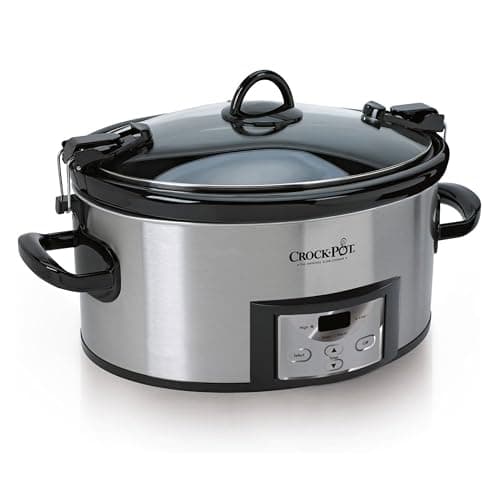 Crock-Pot 6-Quart Cook & Carry Programmable Slow CookerGentle, moist, programmable heat — which is what starchy sides want and what an oven gives them badly. | Best for potatoes, gravy and stuffing | 9.3 | $89.53 · View on Amazon #ad We may earn a commission · Price as of October 10, 2026 |
| 3 | 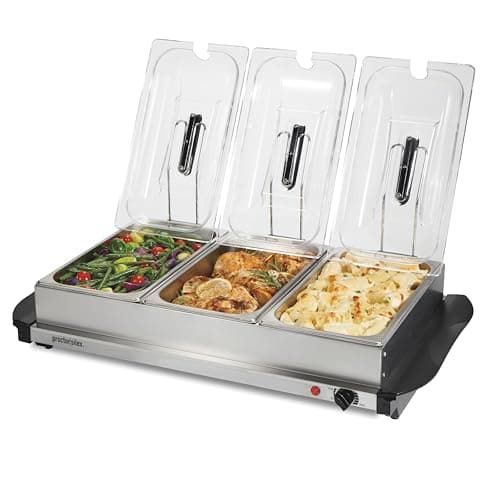 Proctor Silex Electric Buffet Server and Food Warmer with LidsThree 2.5-quart pans with domed lids, which is a leftovers buffet that stays above 140F. | Best for serving what you reheated | 9.0 | $54.99 · View on Amazon #ad We may earn a commission · Price as of October 10, 2026 |
Scores are our own editorial rubric, explained on how we pick. Four criteria per category, scored out of ten, so the leading pick is clear at a glance.
The two rules that apply to everything
Reheat to 165°F, all the way through. That is the internal temperature cooked poultry is taken to, and reheated food needs to get back there rather than merely feeling warm. The failure mode with a microwave is not that it cannot reach 165°F; it is that it reaches it at the edges while the middle is still at refrigerator temperature.
Then keep it at or above 140°F. The 40°F-to-140°F band is where bacteria multiply, and food sitting out at room temperature has a two-hour limit. On the second day that limit is easy to breach, because leftovers get grazed over an afternoon rather than served at a sitting. Hold them properly or put them back in the refrigerator between rounds.
Reheat once, not repeatedly. Take out what you are going to eat, bring that up to 165°F, and leave the rest cold. Reheating the whole dish three times is both a safety problem and the reason turkey ends up like cardboard.
Turkey: the one that goes wrong
Roasted turkey was cooked to doneness once. There is no moisture margin left in it, so reheating with dry heat only takes it further. The answer is to put liquid back.
The method. Lay the sliced meat in a shallow dish, spoon over two or three tablespoons of stock or leftover gravy per portion, cover tightly with foil or a lid, and warm it at a moderate oven temperature — around 325°F — until the center reads 165°F. Fifteen to twenty-five minutes depending on thickness. The foil is not optional; it is what turns the oven into a steam environment.
Slice thicker than you think. Thin slices give up their moisture instantly. Half-inch slices survive reheating far better, which is also an argument for carving leftovers off the carcass rather than reheating slices carved yesterday.
If you must microwave: cover it, add liquid, use medium power rather than full, and stop halfway to rearrange. Full power uncovered is what produced every bad reheated turkey anyone has eaten.
Sides, dish by dish
- Stuffing or dressing. Oven, covered, with a splash of stock, then the last ten minutes uncovered to bring the top back. This is the dish that benefits most from an oven and suffers most in a microwave.
- Mashed potatoes. Stovetop over low heat or a slow cooker, with a splash of milk or cream and a knob of butter stirred through. Never an oven — the top crusts and the middle stays cold.
- Gravy. Small saucepan, low heat, whisked. It will have set solid; it comes back completely. Thin it with stock rather than water.
- Green bean casserole and similar bakes. Oven, covered, then uncovered for the last five to ten minutes to re-crisp the topping. A microwave cannot re-crisp anything.
- Rolls. Wrapped in foil, hot oven, five minutes. They come back remarkably well. Unwrapped, they turn into rusks.
- Roasted vegetables. The exception to the moisture rule: these want a hot oven or a skillet, uncovered, to drive moisture off and bring the edges back.
Reheating for a crowd, not a plate
Reheating one plate is a microwave job. Reheating Thanksgiving dinner for nine the next day is a logistics job, and it is the same logistics problem as the day before — one oven, several dishes, a holding window.
The arrangement that works: turkey and anything moist in a covered roaster oven, casseroles and rolls in the wall oven where they can be uncovered to crisp, potatoes and gravy on the stovetop or in a slow cooker. Then everything moves to a buffet server or a warming tray and stays above 140°F while people serve themselves.
That is three heat sources working in parallel instead of nine microwave cycles in series, and it is the difference between a second dinner and a queue. The full ranking of holding methods is in how to keep food warm for a party.
What you do on the night decides how day two goes
Most of the quality of reheated leftovers is determined before they ever get reheated, and the single biggest factor is how quickly they got cold.
Get food out of the danger zone promptly rather than leaving bowls on a counter while you sit down with a drink. The two-hour room temperature limit applies to the leftovers as much as to the meal. Divide large quantities into shallow containers rather than one deep tub, because a deep container cools from the outside in and the middle spends hours in the wrong temperature band.
Three habits that pay off the next day: carve the remaining meat off the carcass rather than refrigerating a whole bird, keep some of the gravy and stock back specifically for reheating rather than serving all of it, and store the crisp things separately from the wet things. Use the leftovers within the first few days and freeze anything you will not get to.
The products, in detail
#1 · Best for reheating a lot at once
Oster 22-Quart Roaster Oven with Self-Basting Lid
The default answer for most first-time hosts. Twenty-two quarts takes a 26-pound bird, and the dimpled self-basting lid drips condensation back down so you are not opening it every 30 minutes.
The roaster oven is the under-appreciated leftovers appliance, and the reason is the lid. Reheating roasted turkey is a moisture problem: the meat was already cooked to doneness once, so every minute of dry reheating takes it further past that. A covered roaster with a little stock in the base warms the meat in its own humid atmosphere instead of drying it further.
The second half is holding. Leftovers are rarely eaten by everyone at once — people graze over an hour or two — and a roaster that drops to a low setting keeps everything above the 140°F line for that whole window instead of requiring three reheat cycles.
Times and dial settings for the appliance are in roaster oven cooking times, and it is the same trick that makes a ham work.
- Capacity
- 22 qt
- Max bird
- Up to 26 lb
- Lid
- Self-basting
- Insert
- Removable enamel pan
What’s good
- Reheats a large quantity in one go rather than in microwave-sized batches
- Self-basting lid returns condensation, which is precisely what dry turkey needs
- Drops to a holding temperature afterwards so nothing cools while people serve
- Frees the oven for the casseroles that need dry heat
- Removable enamel insert goes straight in the sink
What’s not
- Slow to come up to temperature — this is not the fast option
- Moist heat, so it will not re-crisp anything
- A big appliance to pull out for one plate of leftovers
Result quality
9.4
Capacity
9.6
Holding
9.4
Value
9.2
#ad We may earn a commission · Price as of October 10, 2026
#2 · Best for potatoes, gravy and stuffing
Crock-Pot 6-Quart Cook & Carry Programmable Slow Cooker
The warming appliance most people already own. Mashed potatoes and gravy hold beautifully on Warm; anything with a crust does not.
- Capacity
- 6 qt
- Control
- Programmable, digital timer
- Best for
- Potatoes, gravy, stuffing
- Not for
- Anything crisp
What’s good
- 6 qt holds the whole bowl of mashed potatoes
- Gentle moist heat, so starches warm without a crust forming
- Programmable timer, so it can be reheating while you do something else
- Doubles as the serving vessel, which saves a dish
What’s not
- Not for anything meant to be crisp
- Slow — plan an hour, not fifteen minutes
- Needs stirring, or the edges heat before the middle
Result quality
9.2
Capacity
8.8
Holding
9.6
Value
9.4
#ad We may earn a commission · Price as of October 10, 2026
#3 · Best for serving what you reheated
Proctor Silex Electric Buffet Server and Food Warmer with Lids
Three lidded pans plus a warming surface in the middle. This is the one that turns a kitchen counter into something that reads as a buffet.
- Pans
- Three 2.5 qt stainless
- Lids
- Domed, with lid rests
- Control
- Adjustable dial
- Best for
- Sides and a carving station
What’s good
- Three separate 2.5 qt pans, so turkey, stuffing and potatoes stay separate
- Domed lids with rests keep moisture in and dust out
- Adjustable dial, so you set a holding temperature and leave it
- Turns a second day of leftovers into a proper buffet rather than a queue at the microwave
What’s not
- Holds rather than reheats — food has to go in hot
- Needs counter space and an outlet
- Three 2.5 qt pans is less total capacity than one roaster
Result quality
8.8
Capacity
8.6
Holding
9.4
Value
9.0
Frequently asked questions
165°F, measured in the center of the food rather than at the edge. Afterwards, hold anything that is going to sit out at or above 140°F, because the 40°F-to-140°F range is where bacteria multiply and food left at room temperature has a two-hour limit.
Put moisture back. Lay the slices in a shallow dish, spoon over two or three tablespoons of stock or gravy, cover tightly with foil, and warm at around 325°F until the center reaches 165°F. Thicker slices survive reheating far better than thin ones.
It is the usual reason reheated turkey is disappointing, mostly because people do it uncovered on full power. If the microwave is the only option, cover the dish, add liquid, use medium power and stop halfway to rearrange so the middle heats as well as the edges.
Stovetop over low heat, or a slow cooker, with a splash of milk or cream and a little butter stirred through. An oven crusts the top while the middle stays cold. Stir regularly either way so the edges do not run ahead of the center.
Oven, covered with foil and a splash of stock so the inside steams, then uncovered for the last ten minutes so the top comes back. That second stage is the part a microwave cannot do at all — nothing re-crisps in a microwave.
Avoid it. Take out only what you intend to eat, bring that to 165°F, and leave the rest cold. Repeatedly reheating the whole dish cycles it through the temperature danger zone and destroys the texture of anything that was roasted.
Sources
Related reading
- How to Keep Food Warm for a PartyEight methods ranked, with the 140F safety floor explained and the dishes that simply will not hold.
- The Best Warming Trays for a Holiday BuffetFive ways to hold food above 140F until dinner, ranked — from a 21-inch glass tray to the slow cooker you already own.
- The Best Buffet Servers and Food WarmersLidded electric servers ranked against chafing dishes and a plain warming tray, with the safe holding temperature explained.
- Roaster Oven Cooking Times and TemperaturesThe turkey chart, the ham chart, the stuffed-bird adjustment, and why the dial on the lid is the number you should trust least.
- Roaster Oven vs Slow Cooker for Holiday CookingThe temperature ceiling is the whole difference — 450F versus about 280F. Which appliance cooks the bird, which one holds the sides, and why both end up on the counter.
- A Thanksgiving Cooking Timeline That Fits One OvenBackwards from dinner: what to make two days ahead, the oven schedule, the last hour, and how to hold everything at 140F while the table fills up.