Warming Tray vs Buffet Server
They sit next to each other at the same sort of price and look like the same product. They are not: one heats whatever you put on it, the other decides what goes in it.
By Mike M. · Published · Last updated
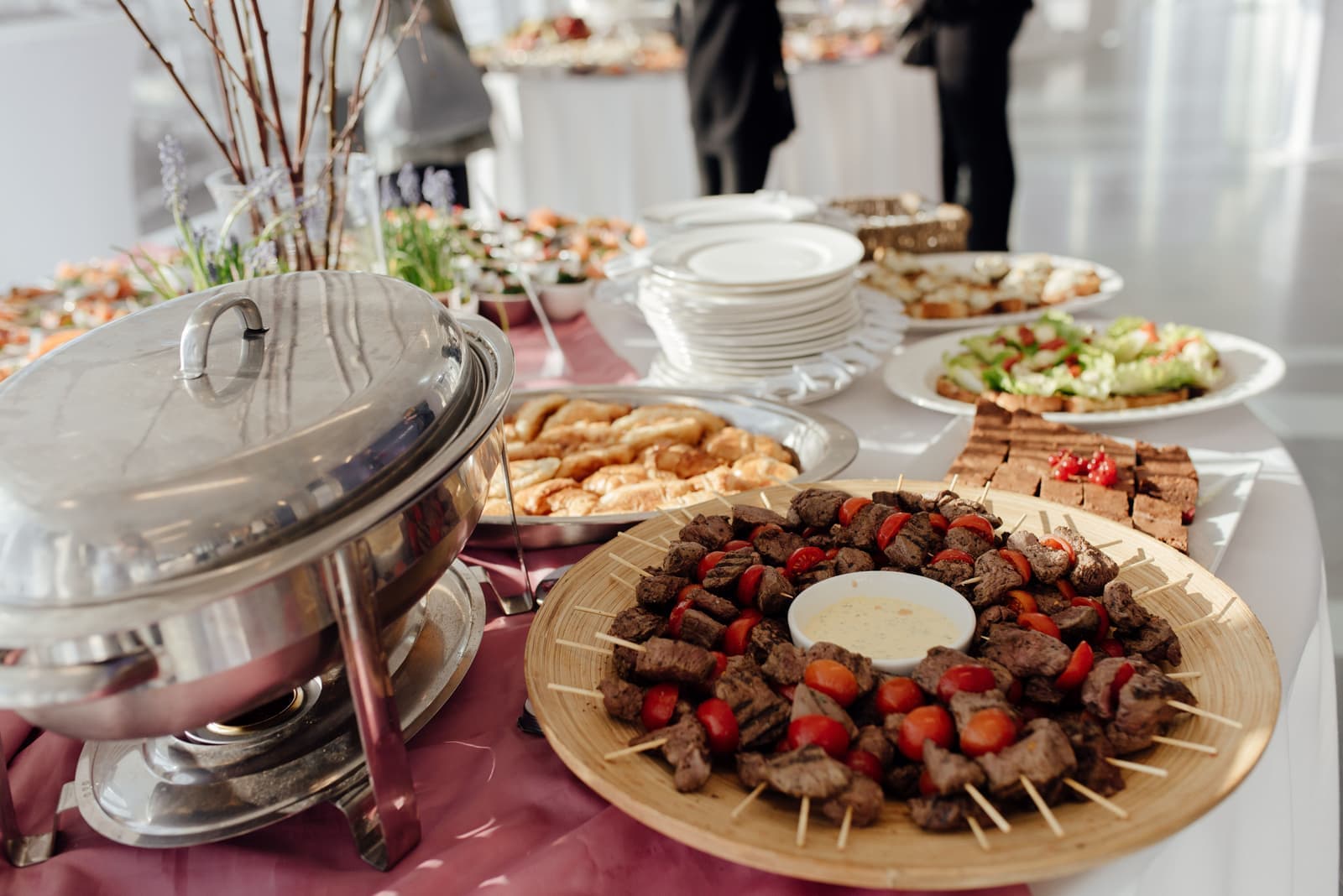
How this page is funded: Fryer & Feast is a participant in the Amazon Associates Program. If you buy through a link here we may earn a commission, at no extra cost to you. It never changes which products we recommend — see how we pick and our full affiliate disclosure. Every buy link goes straight to the retailer, so the price you see is the live one on the day you buy.
Buy a warming tray if your sides are already in dishes you want on the table — a casserole, a gratin, the good serving bowls. Buy a buffet server if the food is loose and needs somewhere to live: mashed potato, stuffing, green beans, gravy.
That is the distinction, and it has nothing to do with price or quality. A warming tray is a heated surface and brings no containers. A buffet server brings its own lidded pans and expects you to use them. Which is right depends entirely on what your menu looks like on the day.
Quick picks
| # | Product | Best for | Score | Price |
|---|---|---|---|---|
| 1 | 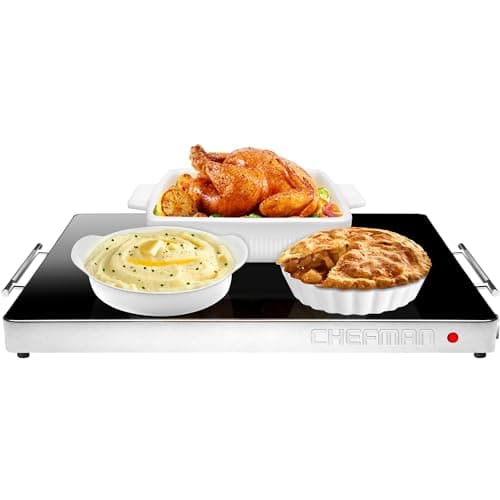 Chefman Electric Warming Tray, 21 x 16 inTwenty-one by sixteen inches of heated glass — big enough for three dishes at once. | Best warming tray | 9.1 | $74.99 · View on Amazon #ad We may earn a commission · Price as of October 8, 2026 |
| 2 | 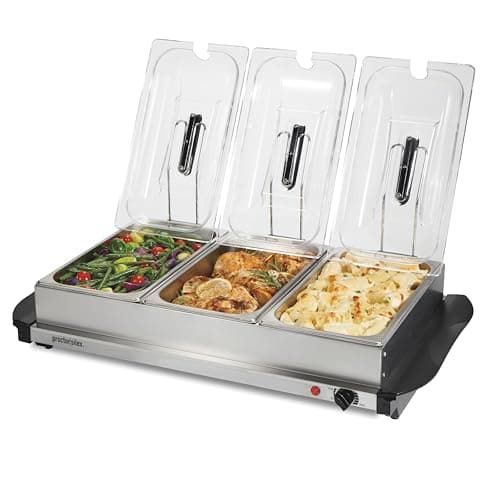 Proctor Silex Electric Buffet Server and Food Warmer with LidsThree lidded stainless pans plus a heated strip in the middle for the carving plate. | Best buffet server | 8.7 | $54.99 · View on Amazon #ad We may earn a commission · Price as of October 8, 2026 |
| 3 | 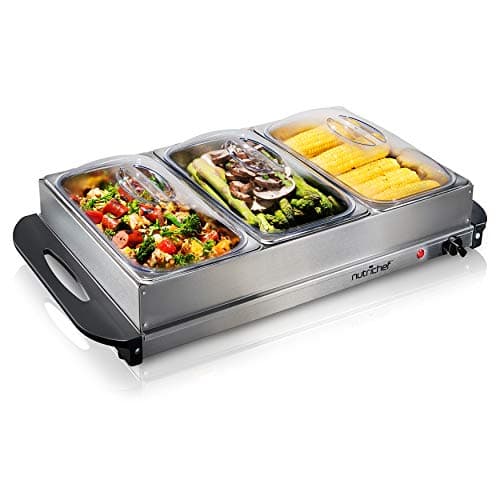 NutriChef Stainless Buffet Warmer Server with 3 TraysThe pans lift out and leave a flat stainless hot plate underneath. | Best of both | 8.8 | $54.99 · View on Amazon #ad We may earn a commission · Price as of October 8, 2026 |
| 4 | 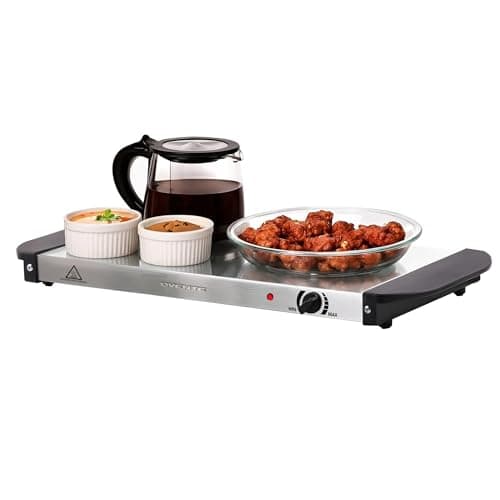 Ovente Compact Electric Warming TrayOne or two dishes, and it goes back in a normal cupboard afterwards. | Best for a small table | 8.3 | $24.99 · View on Amazon #ad We may earn a commission · Price as of October 8, 2026 |
Scores are our own editorial rubric, explained on how we pick. Four criteria per category, scored out of ten, so the leading pick is clear at a glance.
What actually separates them
Strip the marketing away and there are two differences that matter. Everything else follows from them.
One brings containers; one does not. A warming tray is a heated plate. It has no opinion about what sits on it, which makes it flexible and makes it your problem to supply oven-safe dishes that fit. A buffet server arrives with pans sized to its own wells, which removes the guesswork and removes the choice.
One traps heat; one radiates it. Lids are the single biggest functional difference. A covered pan holds temperature dramatically better than an open dish on a hot surface, because the open dish is losing heat from the top the entire time. If you need food to hold for an hour rather than twenty minutes, lids win.
That is why the decision comes down to your menu rather than your budget. Baked and shallow — a gratin, a dish of roast roots, a tray of stuffing with a crust you want to keep — suits a tray, and a lid would ruin the crust anyway. Loose and deep — mash, beans, carrots, gravy — suits lidded pans, because depth plus an open top is exactly the combination that goes lukewarm in the middle.
The number both of them have to clear
Hot food has to be held at or above 140°F. Below that it is in the USDA’s Danger Zone, the band between 40°F and 140°F where bacteria multiply fastest, and two hours in that band is the limit. On a day when the food is ready at four and the last person sits down at five-twenty, this is not a theoretical concern — it is the actual reason to own one of these appliances rather than relying on a low oven and hope.
Two practical consequences:
- These appliances hold; they do not cook. Both categories are designed to maintain temperature, and the dual unit above tops out around 175°F. Food has to arrive hot. A lukewarm casserole put on a warming tray stays lukewarm, which is the worst possible outcome because it looks handled.
- Preheat before the food goes on. A cold tray or a cold pan spends the first fifteen minutes taking heat out of the food instead of putting it in. Switch on ten minutes early, every time.
If you want the number checked rather than guessed, the same instant-read thermometer you use for the bird reads a dish of potatoes perfectly well — see the thermometer roundup. And for the full ranking of ways to hold food, including the three that cost nothing, read how to keep food warm for a party.
Counter space, outlets and where it actually goes
The reason people end up disappointed with either of these is almost never the appliance. It is that there was nowhere sensible to put it.
Measure before you buy. A three-pan buffet server is a long object, and it needs clear run on both sides so people can serve without reaching over a hot lid. A large warming tray is shorter but wants depth. Decide now whether this lives on the dining table or on a counter, because the answer changes which one to buy: a tray can go on a table, a full server usually cannot without dominating it.
Find the outlet first. Both are mains appliances and both will be running at the same time as everything else in your kitchen. Neither draws anything like a fryer or a roaster oven, but a cord crossing a walkway on the day ten people are moving between kitchen and table is a genuine hazard. If the only place the food can go has no outlet near it, the honest answer is not an extension lead across a doorway — it is a chafing dish, which needs no power at all.
Think about serving flow. A buffet server sets up a queue: plates at one end, three pans, carving platter, done. That is a real advantage with twelve guests and no room to pass dishes around a table. A warming tray suits the opposite model — dishes that come to the table and get passed, staying hot between rounds. Neither is better; they describe two different dinners.
Which one you will still own in three years
Worth a thought, because the cupboard is the real test. A flat warming tray stores like a baking sheet and reappears for Christmas, a birthday buffet and any time somebody brings a dish that arrived cold. We would guess it gets used three or four times a year in a house that entertains at all.
A buffet server is a bulkier set — base, three pans, three lids — and it tends to be a holidays-and-parties appliance rather than a casual one. That is not an argument against it; it is an argument for buying the version whose pans lift out, which is why the dual unit above earns its place. On the days you do not need pans, it is a tray.
The combination a lot of hosts end up with, and the one we would recommend if the budget stretches: a buffet server for the sides and a small tray beside it for the gravy, the rolls and whatever arrives late. Two cheap appliances beat one expensive one here, because the problem is surface area as much as heat. If you would rather compare against the no-power option before deciding, read chafing dish versus warming tray, and roaster oven versus turkey fryer covers the big appliance decision that comes before this one.
The products, in detail
#ad We may earn a commission · Price as of October 8, 2026
#1 · Best warming tray
Chefman Electric Warming Tray, 21 x 16 in
The size is the point: 21 by 16 inches takes three serving dishes at once, which is the difference between a warm buffet and one warm side dish.
The case for a warming tray is that it does not impose anything on your table. Whatever the sides are already in — the gratin dish, the enamel roaster, the serving bowl that matches the plates — goes straight on and stays hot. For a host who has thought about how the table looks, that matters more than it sounds like it should, because the alternative is serving everything out of three identical stainless pans.
Size is the specification to pay attention to, and 21 by 16 inches is the useful end of the range. Three dishes at once is the difference between a buffet that holds and one warm side dish with two cooling ones beside it. A compact tray that only takes one dish solves a much smaller problem.
The honest limitation is physics: heat arrives from underneath only. Uncovered mashed potato will form a skin and lose heat from the top no matter what the tray is doing. Cover dishes with foil between servings and stir anything deep. If most of your menu is loose and deep rather than baked and shallow, the buffet server below is the better appliance and it is not a close call.
- Surface
- 21 x 16 in tempered glass
- Control
- Adjustable temperature
- Holds
- About 3 dishes
- Clean
- Wipe-down glass top
What’s good
- 21 by 16 in surface takes about three serving dishes together
- Works with your own dishes, so the table keeps the look you planned
- Adjustable temperature rather than a single on-off setting
- Flat tempered glass wipes clean in seconds
- Stores flat, which is why it still gets used in December
What’s not
- Heats from below only, so uncovered food loses heat from the top
- No lids and no containers — you supply both
- Deep dishes stay hot at the bottom and cool at the top without a stir
- Glass and hot dishes near the table edge is a real consideration with children around
Capacity
9.2
Heat hold
8.4
Flexibility
9.6
Value
9.2
#ad We may earn a commission · Price as of October 8, 2026
#2 · Best buffet server
Proctor Silex Electric Buffet Server and Food Warmer with Lids
Three lidded pans plus a warming surface in the middle. This is the one that turns a kitchen counter into something that reads as a buffet.
This is the one that turns a kitchen counter into something that reads as a buffet, and the reason it holds food better than a tray is simply that the heat is trapped rather than radiating off the top. Three lidded pans at a held temperature will keep stuffing, beans and potato genuinely hot across the long window between “dinner is ready” and everybody actually sitting down.
The trade you are making is control over presentation and an extra round of washing up. Everything has to come out of the pan it was cooked in and go into a stainless pan that looks like every other stainless pan. On a buffet in the kitchen, nobody minds. On a formal table where the dishes were part of the plan, some people do.
The middle warming strip is more useful than it looks: it is where the carving platter or the gravy boat goes, which are the two things that go cold fastest and that no pan will take. If your table runs to more than three sides, a server plus a tray beside it is a common and sensible combination — see the full ranking of warming methods for how to stage a bigger spread.
- Pans
- Three 2.5 qt stainless
- Lids
- Domed, with lid rests
- Control
- Adjustable dial
- Best for
- Sides and a carving station
What’s good
- Three 2.5 qt pans with domed lids, which is the whole holiday side dish problem solved
- Lids trap heat from above, so food holds far better than on an open tray
- Lid rests built in, so hot lids are not going on your tablecloth
- The center section works as a plain warming surface for a platter or gravy boat
- Reads as a buffet instantly — it does the presentation work for you
What’s not
- Your sides have to be decanted into its pans, which means extra washing up
- Three fixed pans is three portions of space whether you need three or not
- A long footprint that wants a counter, not a crowded dining table
- Awkward to store — pans, lids and base are a bulky set
- Pans are shallow, so a large quantity of one side will not fit in one
Capacity
8.6
Heat hold
9.4
Flexibility
7.8
Value
9.0
#ad We may earn a commission · Price as of October 8, 2026
#3 · Best of both
NutriChef Stainless Buffet Warmer Server with 3 Trays
Doubles as a flat hot plate when the pans come out, which makes it more useful the other 360 days of the year than a dedicated chafing set.
- Type
- Buffet server, dual use
- Base
- Stainless hot plate
- Pans
- 3 removable, see-through lids
- Max temp
- 175F
What’s good
- Pans out, and it becomes a plain warming surface for your own dishes
- Genuinely two appliances, so it is the sensible buy if you cannot decide
- Stainless base wipes down rather than needing care
- See-through lids, so you can check without lifting
What’s not
- Holds to about 175F, so it is a holder and not a cooker — food must arrive hot
- As a flat tray it is smaller than a dedicated warming tray
- More parts to store than either single-purpose option
- Three trays again, whether the menu wants three or not
Capacity
8.2
Heat hold
8.8
Flexibility
9.4
Value
8.8
#ad We may earn a commission · Price as of October 8, 2026
#4 · Best for a small table
Ovente Compact Electric Warming Tray
For a small table or a tight counter. It holds one or two dishes and stores upright in a cupboard, which is why it actually gets used again in December.
- Size
- Compact
- Material
- Stainless steel
- Holds
- 1-2 dishes
- Storage
- Fits a standard cupboard
What’s good
- Compact enough to sit on a dining table rather than needing a counter
- Stores upright in a standard cupboard — the main reason it gets reused
- Stainless construction at the budget end of the category
- Cheap enough to buy alongside a buffet server rather than instead of one
What’s not
- One to two dishes only, so it will not hold a full spread
- No lids, same open-top heat loss as any flat tray
- Not the appliance for a table of twelve working on its own
- Fewer temperature options than the larger trays
Capacity
6.8
Heat hold
8.0
Flexibility
8.8
Value
9.4
Frequently asked questions
A warming tray is a flat heated surface that works with your own dishes and brings no containers of its own. A buffet server comes with its own lidded pans sitting in heated wells. The lids are the functional difference: covered pans hold temperature far better, while an open dish on a tray loses heat from the top continuously.
The buffet server, because of the lids. A covered pan traps heat above the food as well as receiving it from below, which matters a great deal across the hour between food being ready and the last guest sitting down. A warming tray can match it if you cover each dish with foil between servings.
No. Both categories are holding appliances, not cookers — some buffet servers top out around 175°F. Food has to go on already hot, and it has to be held at or above 140°F to stay out of the USDA Danger Zone. Reheat in the oven or the microwave first, then transfer.
A large warming tray of around 21 by 16 inches takes about three serving dishes; a compact one holds one or two. A three-pan buffet server holds three sides in 2.5-quart pans, plus a platter or gravy boat on its center warming strip. For a table of twelve with five sides, plan on two appliances.
Often not for the first hour. A roaster oven set low is an excellent warm-hold once the turkey is out and resting, and that covers a lot of ground — see roaster oven versus turkey fryer. What it cannot do is present food for serving, so a tray or server still earns its place on the table rather than in the kitchen.
It is the right answer when there is no outlet where the food needs to be, because it runs on fuel cans rather than mains power. The trade is an open flame on your serving table. Our chafing dish versus warming tray comparison takes that decision apart properly.
Sources
Related reading
- The Best Warming Trays for a Holiday BuffetFive ways to hold food above 140F until dinner, ranked — from a 21-inch glass tray to the slow cooker you already own.
- The Best Buffet Servers and Food WarmersLidded electric servers ranked against chafing dishes and a plain warming tray, with the safe holding temperature explained.
- Chafing Dish vs Warming TrayPower, safety and heat retention compared — and the case for owning one of each.
- How to Keep Food Warm for a PartyEight methods ranked, with the 140F safety floor explained and the dishes that simply will not hold.
- Roaster Oven vs Turkey FryerBird size, timing, risk, skin and what each one does after the turkey comes out — plus the one answer that suits most first-time hosts.
- The Best Chafing Dishes for Home UseFour chafers sized for a home sideboard rather than a banquet hall, with the lid types compared and the flame rules spelled out.