The Best Casserole Carriers for a Dish You Have to Drive
A casserole carrier cannot heat your food. It can only slow down how fast it loses what it already has, which is why what matters is insulation, a base that does not leak and a dish that goes in hot.
By Mike M. · Published · Last updated
How this page is funded: Fryer & Feast is a participant in the Amazon Associates Program, and in brand partner programs run through the Impact network — currently Pit Boss, which sells direct. If you buy through a link here we may earn a commission, at no extra cost to you. It never changes which products we recommend — see how we pick and our full affiliate disclosure. Every buy link goes straight to the retailer, so the price you see is the live one on the day you buy.
No carrier makes food hotter — it only slows the rate at which heat leaves. That single fact decides everything about buying one. A carrier with thick foam and a foil lining buys you a couple of hours; a thin tote buys you twenty minutes. Neither will rescue a dish that came out of the oven an hour before you left, and no carrier is a substitute for putting the food in hot and keeping the lid shut.
Which means the specification worth reading is not the fabric or the pattern. It is the thickness of the insulation, whether the base seams are welded so a bubbling sauce cannot leak into your car, and whether the thing actually fits the dish you own. All five picks below were confirmed on sale as new units during the build of this page, and the prices update live from the listing.
Quick picks
| # | Product | Best for | Score | Price |
|---|---|---|---|---|
| 1 | 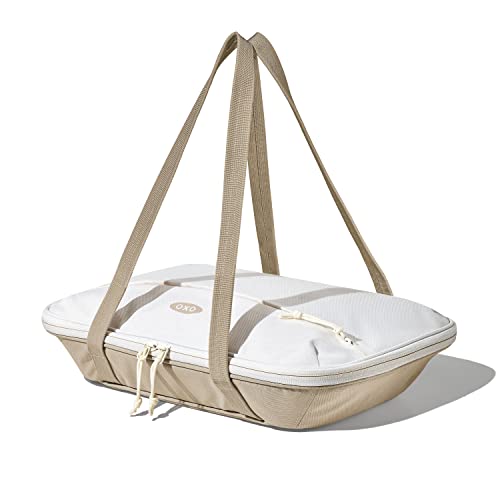 OXO Good Grips Insulated Casserole Carrier, Fits 9 x 13 inThe one here from a brand with a reputation to protect, and the only lining we would be happy to wipe out over a sink and use again next week. | Best overall | 9.3/10 | $34.99 · See the OXO 9x13 carrier #ad We may earn a commission · Price as of November 22, 2026 |
| 2 | 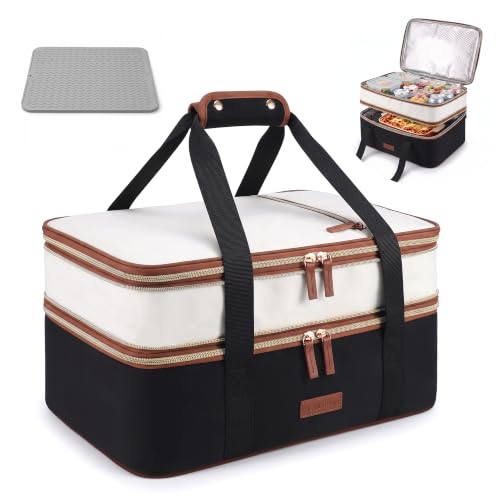 HOMESPON Expandable Double Decker Casserole Carrier, 9 x 13 inFlat for one 9-by-13, or unzip the upper tier and it swallows two. The stiffened sides mean it holds its shape instead of slumping around the dish. | Best for two dishes | 9.5/10 | $26.59 · See the HOMESPON expandable #ad We may earn a commission · Price as of November 22, 2026 |
| 3 | 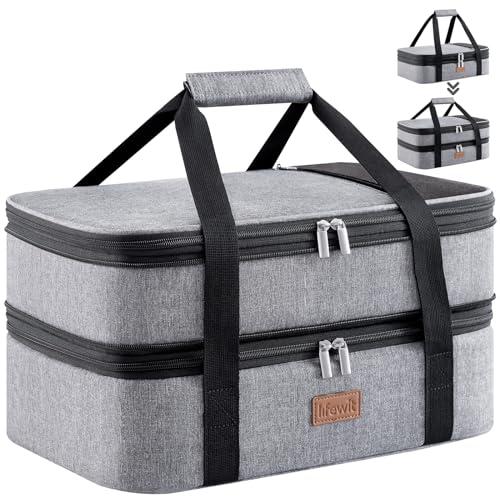 Lifewit Expandable Insulated Double Decker Casserole CarrierTwo dishes for roughly what one good single carrier costs, with the thickest published insulation here and a leakproof pressed base. | Best value for two dishes | 9.4/10 | $23.78 · See the Lifewit double decker #ad We may earn a commission · Price as of November 22, 2026 |
| 4 | 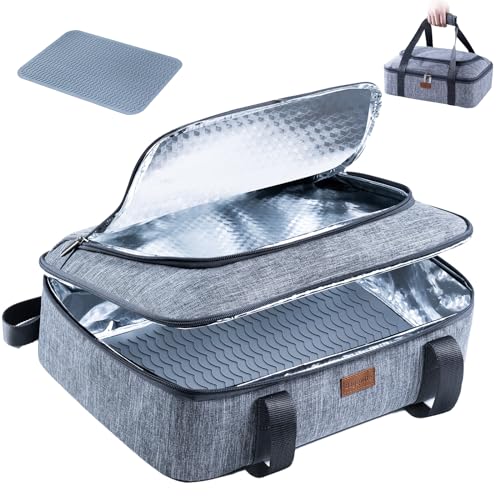 BAGSPRITE Insulated Casserole Carrier with Heat-Resistant MatLeast money here, and the only one that includes the silicone mat for the counter you are about to put a 400-degree dish down on. | Budget pick | 8.9/10 | $16.99 · See the BAGSPRITE carrier #ad We may earn a commission · Price as of November 22, 2026 |
| 5 | 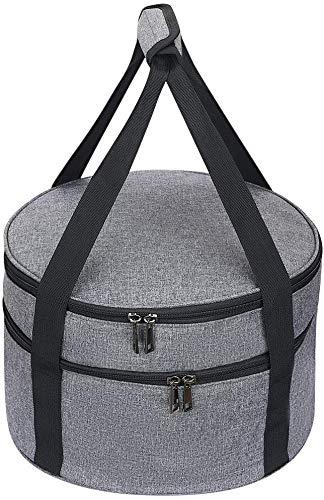 Insulated Pie and Casserole Carrier, 12.5 in, Expandable for Two PiesCasserole carriers are built around a rectangle. If what you are carrying is a round baker, a cobbler or two pies, this is the shape that actually fits. | Best for round dishes | 9.1/10 | $20.99 · See the Insulated 12.5 in #ad We may earn a commission · Price as of November 22, 2026 |
Scores are our own editorial rubric, explained on how we pick. Four criteria per category on a published 8.4-9.8 scale, so the leading pick is clear at a glance. A product scores the same here as it does on every other page of this site.
What a carrier does, and the rule that matters more
An insulated carrier is a passive device. It has no heat source, so the only thing it can do is slow the rate at which your food loses the heat it already had. Everything that makes one carrier better than another — foam thickness, a foil lining, a welded base, a close fit around the dish — is about slowing that loss.
That makes the food-safety arithmetic the real constraint. The USDA calls 40 to 140 degrees Fahrenheit the danger zone, because bacteria multiply fastest in it, and the standing rule is that perishable food should not sit in that band for more than two hours in total. A carrier helps you stay out of it; it does not exempt you from counting.
Practically, that means three things. Put the dish in hot, not warm. Keep the total time from oven to table under two hours, including the drive and the hour it sits on the host’s counter waiting for everyone to arrive. And if the meal is running late, get the dish back to heat rather than trusting the bag — a chafer, a warming tray or a low oven, as covered in how to keep food warm for a party.
Single, double decker or round: pick the shape first
Shape is the decision that cannot be undone later, and it is the one most people get wrong.
- Single 9-by-13. The default. One standard rectangular dish, the flattest package in the car, and the lightest carry. If you bring one dish to one dinner, buy this and stop.
- Expandable double decker. Flat for one dish, unzipped for two. This is the shape for the household that brings a main and a side, or a casserole and a dessert, and it costs almost nothing extra. The trade is bulk and weight when it is full.
- Round. For round bakers, cobblers and pies. A rectangular carrier will not take a 12-inch round dish, so if that is what you own, this is the only shape that works.
Measure your dish before you buy anything, with the lid on if it has one. Published fits are for a standard 9-by-13 pan, and a deep-dish lasagna pan with handles is a bigger object than that.
What to look for, in the order it matters
The listings in this category all sell on patterns and fabric colors. None of that affects whether your food arrives hot.
- Insulation thickness. The number to look for is the foam: 7 to 8 mm of EPE foam behind a foil lining is the top of this market, and the makers that publish the figure are generally the ones that have it.
- A sealed base. Hot-press welded seams rather than stitching. Stitched seams are a wick: cheese sauce finds them, goes through, and sets in the foam. This is the most common way a carrier dies.
- A lining you can wipe. Smooth aluminum foil rather than textured fabric. Quilted interiors look nicer and hold onto everything that spills.
- Structure. Boards in the base and sides keep the bag square when a dish comes out, which matters when the second dish is still inside.
- Handles and a pocket. Padded handles that work with mitts on, and a pocket for a serving spoon. Trivial until you are standing in a stranger’s kitchen with a hot dish and no spoon.
What we would not pay extra for: shoulder straps, which put a hot dish against your body; and claims about keeping food hot for eight or twelve hours, which are not meaningful without stated conditions.
How to pack one so the food is still hot
The carrier is maybe a third of the result. The rest is how you load it, and all of it is free.
- Go in hot and go in last. Straight from the oven into the bag, into the car, and leave. Every ten minutes on the counter is ten minutes of heat you are not getting back.
- Cover the dish itself. A lid, or foil pressed down onto the rim. The bag slows heat loss; a cover slows evaporation, which is what dries out the top of a casserole on a long drive.
- Fill the air gaps. A folded kitchen towel over the dish and down the sides. Air moves heat; towels stop it moving, and they soak up anything that escapes the dish.
- Preheat the carrier in cold weather. A hot damp towel in the empty bag for a few minutes, then out before the dish goes in. A room-temperature carrier takes its first heat from your food.
- Keep it level and off the floor. A footwell is the coldest part of a car and the easiest place for a dish to tip. A flat seat with the bag against the backrest is better.
If the drive is longer than about forty minutes, stop thinking of it as transport and plan to reheat at the other end. The method that does least damage to a cooked side dish is in how to reheat Thanksgiving leftovers.
If you are the one hosting, buy the other half of this
Hosts have the mirror-image problem: four guests arrive within ten minutes of each other, each with a hot dish, and dinner is forty minutes away. Carriers cannot hold food for forty minutes at a safe serving temperature, and your oven is full of turkey.
Two things solve it cheaply. A chafing setup holds several dishes above the safe line for hours on canned fuel, and the budget end of that market is better than people expect — see the best chafing dishes under $100. An electric warming tray is the simpler answer for two or three dishes on a sideboard, and keeping appetizers warm covers the hour before the meal.
And if the plan is to put a guest’s casserole in a roaster oven to hold it, that works well — roaster ovens under $100 are the cheapest way to own a second oven that doubles as a warmer.
Which one should you buy?
One dish, bought once, used for years: the OXO. Best lining, best handles, and the brand most likely to still be making them when you need a second.
Two dishes: the HOMESPON if you want it to stand up by itself and bring a trivet, the Lifewit if you want the same two-dish capacity for less money and will accept a bag that slumps.
Twice a year, short drive: the BAGSPRITE. It includes the mat, it costs the least, and the gap between cheap and good insulation does not show up on a ten-minute trip.
Round dishes or pies: the QCWN round carrier, and read the pie carrier roundup if the dessert is the thing you are protecting.
Whichever you buy, the dish goes in hot and the clock starts when it leaves the oven. That matters more than anything on this page.
Every pick, in detail
#ad We may earn a commission · Price as of November 22, 2026
#1 · Best overall
OXO Good Grips Insulated Casserole Carrier, Fits 9 x 13 in
Foam insulation over an aluminum fabric lining that wipes clean, a zip pocket on the front for the serving spoon, and handles wide enough for a full glass dish.
OXO publishes this as an insulated carrier that keeps dishes hot or cold for hours using foam insulation and an aluminum fabric lining, with a lining that wipes clean and protects against spills and drips, an exterior front zippered pocket for serving utensils and napkins, generous handles, a fit for most 9-by-13 bakeware, and an exterior made from recycled material.
The part that earns the extra money is the lining. Carriers get used for lasagna, baked ziti, and sweet potato casserole with marshmallow on top, and all three leak, drip or caramelize onto something. A foil lining you can genuinely wipe out is the difference between a carrier you use for a decade and one you bin in January because it smells.
The front pocket is the second quiet win. If you have ever arrived with a dish and then discovered the host has no serving spoon free, you know why. Keep a spoon, a trivet and a couple of napkins zipped into the front and the carrier becomes the whole kit rather than just the bag. If what you are carrying is dessert rather than a side, our pie carrier roundup covers the rigid options.
- Fits
- Most 9 x 13 in bakeware
- Lining
- Foam plus aluminum fabric
- Storage
- Front zippered utensil pocket
- Exterior
- 100% recycled fabric
Why we picked it
- Foam insulation over an aluminum fabric lining that wipes clean
- Fits most 9 x 13 in bakeware, including heavy glass dishes
- Zip pocket on the front holds the serving spoon and napkins
- Wide, long handles that work with oven mitts on
- Exterior fabric and pockets made from 100% recycled material
Good to know
Single dish only - no expanding upper tier at this price
Insulation
9.3
Build
9.8
Cleaning
9.7
Value
8.4
#ad We may earn a commission · Price as of November 22, 2026
#2 · Best for two dishes
HOMESPON Expandable Double Decker Casserole Carrier, 9 x 13 in
One 9-by-13 flat or two when you unzip the upper tier, with board-stiffened sides that hold their shape and a silicone base mat that comes out as a trivet.
HOMESPON publishes this as a carrier measuring 16 by 11.8 by 4.7 inches in single-deck mode for one 9-by-13 dish, expanding to 23 liters for two when you unzip the 3.5-inch upper tier, with hot-press welded bottom seams to help contain bubbling sauces, a removable silicone base mat that can be placed on the table as a heat rest, PP boards supporting each tier, a waterproof Oxford outer with pearl cotton foam and a wipe-clean foil lining, and dual zips that let the lid fold 180 degrees open.
The structure is the real differentiator in this category. Most casserole totes are a fabric bag with foam in the walls, which means that when you lift a full glass dish out, the whole thing collapses sideways and whatever is left inside tips. Boards in the base and the tiers keep it square, and that is worth more in practice than another millimeter of foam.
The silicone mat is the detail we would miss most. Arriving with a scorching dish and nowhere to put it is the standard moment of panic in someone else’s kitchen; pulling a mat out of the bag it came in solves it. Be honest about the weight, though: two loaded 9-by-13 dishes is a genuinely heavy carry, and this is a two-hands-and-no-stairs object when it is full.
- Flat size
- 16 x 11.8 x 4.7 in, one dish
- Expanded
- 23 L, two 9 x 13 in dishes
- Base
- Welded seams, removable mat
- Opening
- Dual zip, folds fully open
Why we picked it
- 16 x 11.8 x 4.7 in flat for one dish; unzips to 23 L for two
- PP support boards in each tier, so it stands up empty or full
- Hot-press welded base seams to contain a bubbling sauce
- Removable silicone base mat doubles as a trivet at the other end
- Dual zips let the lid fold fully open, so no tilting to load
Good to know
Two full dishes is heavy, and the handles carry all of it
Capacity
9.8
Structure
9.6
Insulation
9.2
Value
9.3
#ad We may earn a commission · Price as of November 22, 2026
#3 · Best value for two dishes
Lifewit Expandable Insulated Double Decker Casserole Carrier
Two dishes for about what one good single carrier costs: 7 mm foam behind food-grade foil, a leakproof hot-pressed base and a top tier that unzips when you need it.
Lifewit publishes this one as an expandable double-decker carrier measuring 15.8 by 10 by 5.1 inches, expanding to 7.1 inches, with an inner layer of food-grade aluminum foil and 7 mm EPE foam stated to keep food cold, hot or fresh for up to six hours, a hot-pressed leakproof foil construction, a 600D exterior, wide openings with zip closures, two carry handles and a top zip pocket.
Seven millimeters of foam is as thick as anything on this page, and in a carrier that is the number that matters most. Treat the six-hour claim as a best case in a warm car with the bag full and closed, rather than a promise: an insulated bag loses heat fastest when it is half empty, because the air inside carries it away. Fill it, and fill the gaps with a folded towel.
Against the HOMESPON above, you are trading structure for money. This one carries the same two dishes and insulates at least as well; it just does not stand up by itself and does not bring a mat. If you are bringing a side dish and planning to serve it from the carrier rather than the host’s oven, read how to keep food warm for a party before you leave.
- Size
- 15.8 x 10 x 5.1 in, 7.1 expanded
- Insulation
- 7 mm EPE foam, food-grade foil
- Maker claim
- Hot or cold up to 6 hours
- Exterior
- 600D fabric, padded handles
Why we picked it
- 15.8 x 10 x 5.1 in, expanding to 7.1 in for a second dish
- 7 mm EPE foam behind a food-grade aluminum foil lining
- Maker states hot, cold or fresh for up to 6 hours
- Hot-pressed leakproof foil base, easy to wipe out
- 600D exterior with two padded handles and a top zip pocket
Good to know
No rigid boards, so it slumps when you lift a dish out
Insulation
9.5
Capacity
9.5
Build
8.7
Value
9.8
#ad We may earn a commission · Price as of November 22, 2026
#4 · Budget pick
BAGSPRITE Insulated Casserole Carrier with Heat-Resistant Mat
Cheapest honest carrier of the group, and the only one that ships with a silicone mat for the counter you are about to put a scorching dish down on.
BAGSPRITE publishes this as an insulated carrier that fits 9-by-13 baking dishes and foil pans, supplied with a non-slip silicone heat-resistant mat for the counter, with a heavy insulated pad and an aluminum lining that wipes clean, a quilted exterior and a top utility pocket with a zip closure for plates and oven mitts.
For an annual potluck, this is the sensible amount of money to spend. The difference between a cheap carrier and a good one shows up on an hour-long drive in cold weather, not on the ten-minute run to a neighbor’s house, and if you bring a dish somewhere twice a year the cheap one is the right economics.
The mat is a genuine inclusion rather than a bundled extra nobody wants. Hosts rarely have a free trivet when four people arrive at once carrying hot food, and a silicone mat also stops the carrier sliding around a car seat on the way. What you are giving up is structure and a published insulation spec — this is a foil-lined bag, and it behaves like one.
- Fits
- 9 x 13 in dishes and foil pans
- Included
- Non-slip silicone heat mat
- Lining
- Quilted, aluminum, wipe clean
- Storage
- Zip utility pocket on top
Why we picked it
- Cheapest pick on this page, and by a wide margin
- Non-slip silicone heat-resistant mat included in the box
- Fits 9 x 13 in dishes and the foil pans people actually use
- Quilted aluminum-lined interior that wipes down
- Zip utility pocket on top for plates and oven mitts
Good to know
Single dish only, with no expanding tier
Value
9.8
Insulation
8.4
Extras
9.5
Build
8.4
#ad We may earn a commission · Price as of November 22, 2026
#5 · Best for round dishes
Insulated Pie and Casserole Carrier, 12.5 in, Expandable for Two Pies
Least money on this page, and it still carries two pies warm in water-resistant oxford with real handles.
The maker publishes this as a 12.5-inch diameter by 7.87-inch tall insulated carrier in 1680D water-resistant oxford, expandable to take two to three pies or round dishes.
It is on this page for a reason worth saying out loud: a rectangular carrier is useless for a round dish, and most cobblers, deep-dish casseroles and holiday desserts come in round bakers. Buying the wrong shape is the most common mistake in this whole category, and it is not recoverable — a 12-inch round baker simply will not sit flat in a 9-by-13 bag.
Because it stacks, the weight of the upper dish bears on the lower one, so put the sturdiest dish at the bottom and do not stack a meringue. For pies specifically, rigid carriers with clamped lids protect the surface better, and those are covered in the best pie carriers.
- Size
- 12.5 in D x 7.87 in H
- Capacity
- Two to three pies, expandable
- Material
- 1680D water-resistant oxford
- Best for
- Potlucks and short drives
Why we picked it
- Round, 12.5 in across and 7.87 in tall - takes a deep dish
- Expandable for two to three round dishes stacked
- 1680D water-resistant oxford, the toughest fabric here
- Handles sized for carrying it with the dishes stacked
- Costs about the same as the budget rectangular pick
Good to know
Will not hold a 9 x 13 rectangular dish at all
Round-dish fit
9.8
Durability
9.4
Capacity
8.9
Value
9.5
Frequently asked questions
Makers of the thicker bags state up to six hours, and that is a best case: a full bag, zipped, going in straight from the oven, in a warm car. In normal use, plan on an hour or two of genuinely hot food. The limit that matters is not the bag anyway - perishable food should not spend more than two hours in total between 40 and 140 degrees Fahrenheit, and the drive counts toward that.
Not reliably, and that is not what it is for. A carrier slows heat loss; it does not hold a temperature. If the food will not be eaten within about two hours of leaving the oven, it needs a heat source at the other end - a low oven, a warming tray, a chafer or a roaster oven on its lowest setting.
Match it to your dish, not to the meal. A standard 9-by-13 inch baking dish is what almost every rectangular carrier is built around; measure yours with its lid on, because deep-dish pans with handles are bigger than the nominal size. Round bakers need a round carrier - a 12-inch round dish will not sit flat in a 9-by-13 bag.
Buy the expandable double decker if you ever bring two things, which most people do - it folds flat for one dish and costs very little more. Buy a single if you want the lightest, flattest package in the car and you only ever carry one dish. The penalty for the double is bulk and weight when it is fully loaded.
Yes - these are built for it, with foil-lined, foam-insulated interiors rated for hot food. Put a lid or pressed foil on the dish first so steam does not condense all over the lining, and use the handles with mitts. What you should not do is set a scorching dish down on a laminate counter or a car seat at the other end, which is why the picks that include a silicone mat are worth the extra.
Wipe the foil lining out with a damp cloth and mild soap, then leave it open to dry completely before it goes away - trapped damp is what makes a carrier smell. Do not put a foam-insulated carrier in the washing machine or the dryer. Carriers with welded rather than stitched base seams are far easier to get properly clean, because nothing has soaked into the stitching.
A hard cooler insulates better but is the wrong shape: a 9-by-13 dish does not sit flat in most of them, and a dish that tips in transit is the thing you are trying to prevent. A carrier built around the dish, with a welded base and a utensil pocket, is both easier to carry and less likely to end with lasagna in your footwell.
Our recommendation
If you only take one thing from this page: buy the OXO 9x13 carrier. If that is not the right fit for your setup, the HOMESPON expandable is the one to get instead.
Best casserole carrier
9.3/10OXO Good Grips Insulated Casserole Carrier, Fits 9 x 13 in
The one here from a brand with a reputation to protect, and the only lining we would be happy to wipe out over a sink and use again next week.
#ad We may earn a commission · Price as of November 22, 2026
Runner-up — Best for two dishes
9.5/10HOMESPON Expandable Double Decker Casserole Carrier, 9 x 13 in
Flat for one 9-by-13, or unzip the upper tier and it swallows two. The stiffened sides mean it holds its shape instead of slumping around the dish.
#ad We may earn a commission · Price as of November 22, 2026
Brands: want your product tested? For Brands.
Sources
- OXO Good Grips Insulated Casserole Carrier — manufacturer published specifications (foam insulation with aluminum fabric lining, fits most 9x13 bakeware, front zippered utensil pocket, 100% recycled exterior fabric)
- HOMESPON Expandable Double Decker Casserole Carrier — manufacturer published specifications (16 x 11.8 x 4.7 in flat for one 9x13 dish, unzips to 23 L for two, hot-press welded leakproof base seams, removable silicone base mat, dual-zip 180-degree opening, PP support boards)
- Lifewit Expandable Insulated Double Decker Casserole Carrier — manufacturer published specifications (15.8 x 10 x 5.1 in, 7.1 in expanded, 7 mm EPE foam with food-grade aluminum foil, stated hot or cold up to 6 hours, 600D exterior, hot-pressed leakproof base)
- BAGSPRITE Insulated Casserole Carrier with Heat-Resistant Mat — manufacturer published specifications (fits 9 x 13 dishes and foil pans, non-slip silicone heat-resistant mat included, quilted aluminum-lined interior, zip utility pocket on top)
- Insulated Pie and Casserole Carrier, 12.5 in — manufacturer published specifications (12.5 in D x 7.87 in H, 1680D water-resistant oxford, expandable for two to three pies)
- USDA Food Safety and Inspection Service — "Danger Zone" (40F-140F)
Related reading
- The Best Pie CarriersFive pie carriers worth owning - a hard-shell whose base flips into a serving tray, an insulated tote that holds heat for hours, two different two-packs, and a budget insulated case for two pies.
- How to Keep Food Warm for a PartyEight methods ranked, with the 140F safety floor explained and the dishes that simply will not hold.
- How to Keep Appetizers Warm at a PartyHolding appetizers hot for a long window: what works for dips and meatballs, why crisp food needs an open rack instead of a chafer, and the 140F and two-hour rules.
- The Best Chafing Dishes Under $100Six chafing setups under $100 - the VEVOR two-pack of 8 qt stainless chafers, the fold-flat Sterno set, the Winco half-size, two disposable kits and a 6-pack of wire racks - with what the budget ceiling actually costs you.
- How to Reheat Thanksgiving LeftoversThe 165F rule, the stock trick that saves sliced turkey, and the right appliance for stuffing, potatoes, gravy and casseroles.
- The Best Warming Trays for a Holiday BuffetFive ways to hold food above 140F until dinner, ranked — from a 21-inch glass tray to the slow cooker you already own.
- The Best Roaster Ovens Under $100Five roaster ovens that come in under $100 - the MegaChef 22-quart, the VEVOR 22-quart with a window in the lid, the Sunvivi 20-quart with a defrost setting, the NESCO 18-quart and a 6-quart for sides - with what the budget costs you.