Brining vs Injecting a Turkey
One needs a day, a container and fridge space you probably do not have. The other needs fifteen minutes and a two-ounce syringe. They are not the same job, and only one of them is about moisture.
By Mike M. · Published · Last updated
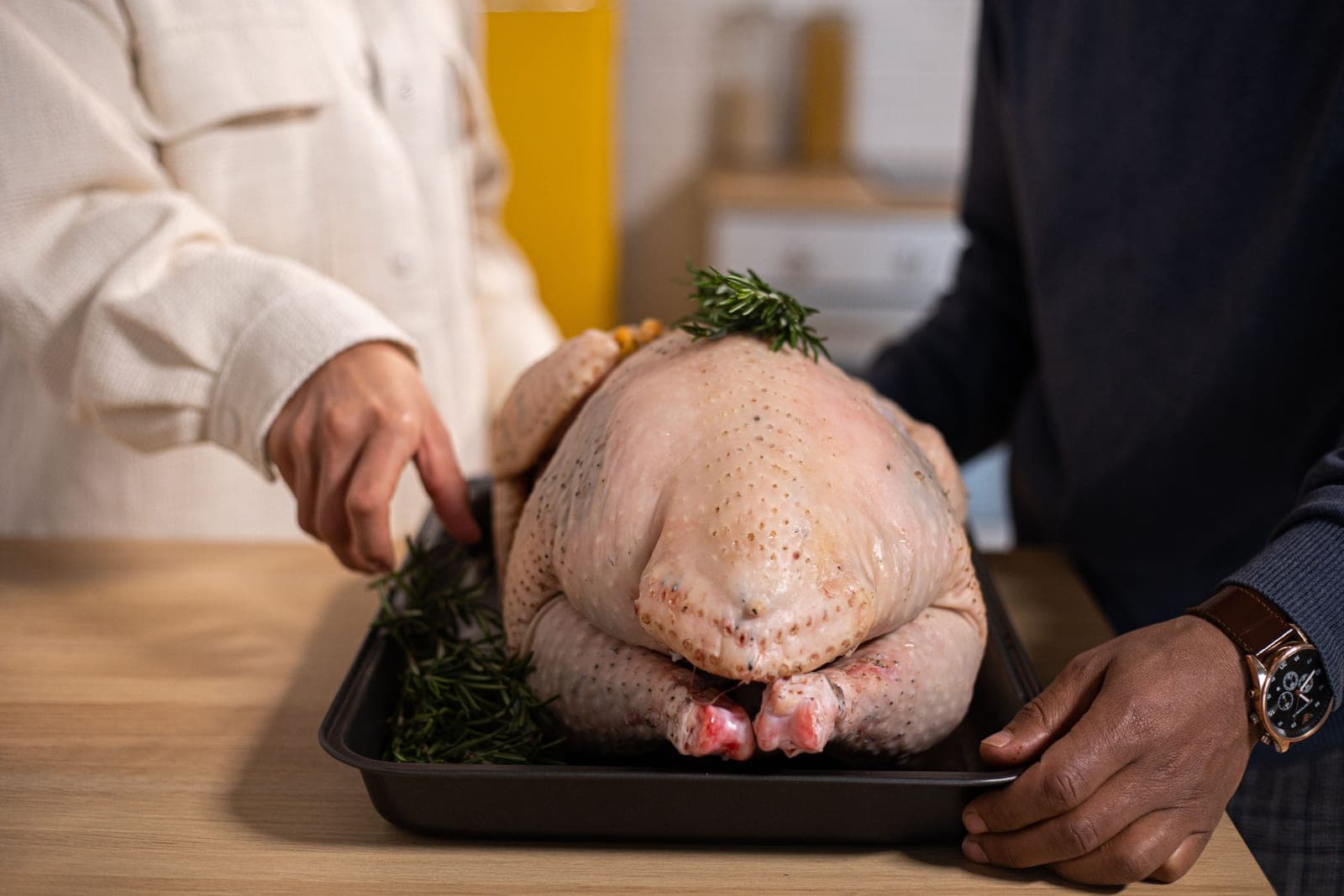
How this page is funded: Fryer & Feast is a participant in the Amazon Associates Program. If you buy through a link here we may earn a commission, at no extra cost to you. It never changes which products we recommend — see how we pick and our full affiliate disclosure. Every buy link goes straight to the retailer, so the price you see is the live one on the day you buy.
Brine if you have a day and the refrigerator space. Inject if you have fifteen minutes. Brining salts the entire bird and makes it more forgiving if you overcook it; injecting puts concentrated flavor deep into the breast and thigh and does almost nothing for the skin or the wings. For a first-time host the honest ranking is: dry brine first, inject second, wet brine third.
You can do both, with one caution — if the bird is already injected at the plant (a self-basting or “enhanced” turkey, which the label will say) or you have already brined it, skip the salt in your injection. Salting a bird twice is the one combination that ruins dinner.
Quick picks
| # | Product | Best for | Score | Price |
|---|---|---|---|---|
| 1 | 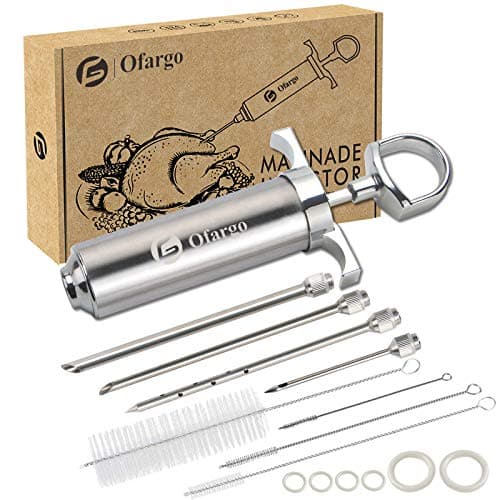 Ofargo Stainless Steel Meat Injector KitA two-ounce stainless barrel with enough pressure to push marinade into a breast instead of dribbling it back out. | Best for injecting | 8.9 | $27.99 · View on Amazon #ad We may earn a commission · Price as of October 15, 2026 |
| 2 | 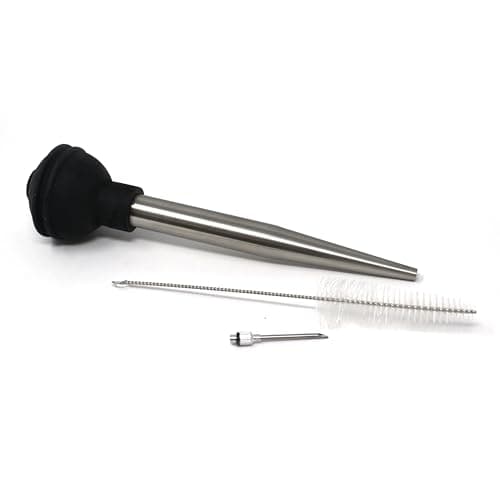 Norpro Deluxe Stainless Baster with Injector and BrushA baster that also injects, with the cleaning brush most of them leave out. | Best budget injector | 8.8 | $12.47 · View on Amazon #ad We may earn a commission · Price as of October 15, 2026 |
| 3 | 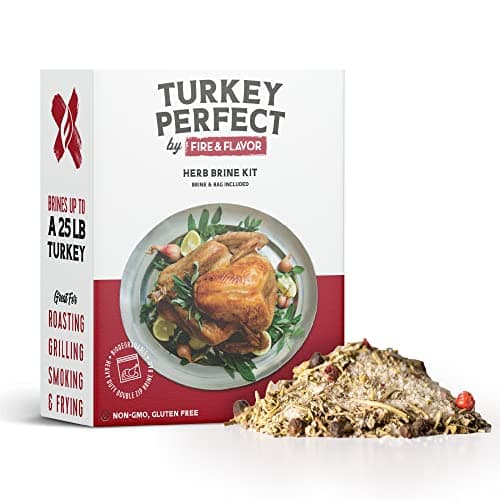 Fire & Flavor Turkey Perfect Brine KitMeasured salt and aromatics plus a bag rated to 25 pounds, so there is nothing to weigh and nothing to improvise. | Best for brining | 9.3 | $14.95 · View on Amazon #ad We may earn a commission · Price as of October 15, 2026 |
| 4 |  Heavy-Duty Turkey Brining Bags, Set of 2Two heavy bags rated to 38 pounds, which is the cheapest way to wet-brine without owning a bucket. | Best brining vessel | 9.0 | $10.99 · View on Amazon #ad We may earn a commission · Price as of October 15, 2026 |
| 5 | 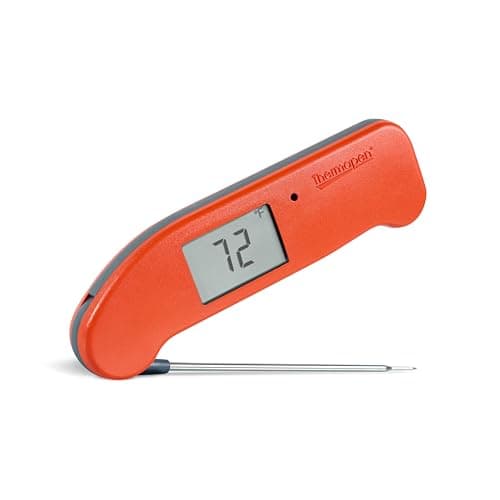 ThermoWorks Thermapen ONE Instant-Read ThermometerNeither method saves an overcooked bird. A one-second probe does. | What actually decides dinner | 9.4 | $125.00 · View on Amazon #ad We may earn a commission · Price as of October 15, 2026 |
Scores are our own editorial rubric, explained on how we pick. Four criteria per category, scored out of ten, so the leading pick is clear at a glance.
What each one actually does
Brining is salt and time. Salt in solution works inward through the whole bird, and that is the point: it seasons meat all the way through rather than only on the surface, and it changes how the muscle holds liquid so the bird survives a few extra minutes in the oven. The coverage is even and the flavor is background — seasoned turkey that tastes like turkey.
Injecting is flavor and placement. You are putting a seasoned liquid directly into the thick muscle, where no surface treatment reaches in the time available. Butterball’s method is to fill the needle injector, insert it into the breasts and thighs, and inject each thigh and each side of the breast with half an ounce for every five pounds of bird. The result is noticeably more flavored in the places you injected and unchanged everywhere else.
That difference explains most of the arguments about these two methods. Brining is insurance and seasoning. Injecting is flavor delivery. If you ask injecting to make a lean breast more forgiving you will be disappointed, and if you ask a brine to make a bird taste like Cajun butter you will be disappointed too.
Neither one is a substitute for cooking the bird correctly. Published guidance puts cooked poultry at 165F internal, measured in the thickest part of the breast and the inner thigh away from bone. A brine buys you a small margin at that line. It does not buy you twenty minutes.
The real cost: time, space and mess
This is where the decision usually gets made, and it has nothing to do with flavor.
- Wet brine: 12 to 24 hours, a container big enough to submerge a turkey, and a refrigerator shelf cleared for it in the week your refrigerator has least room. Plus the brine itself, which has to be made and cooled before the bird goes in. Then you rinse and pat the bird dry.
- Dry brine: overnight, one normal shelf, no container and no liquid. You rub salt over and under the skin and leave the bird uncovered in the refrigerator. It also gives better skin than a wet brine, because the surface dries out instead of taking on water.
- Injecting: about fifteen minutes, right before the bird goes in. No container, no fridge space, no planning beyond buying the marinade. The mess is local and immediate — marinade sprays a little, so do it in the sink or the roasting pan.
Put plainly: the method you can actually execute on the day beats the one that is theoretically better. A first-time host with a full refrigerator and a 22-pound bird arriving on Tuesday should dry brine or inject, not try to find five gallons of fridge space for a bucket.
Food safety runs the same way for both. A brining bird lives in the refrigerator, not on the counter — between 40F and 140F is where bacteria multiply fastest. An injector goes into raw meat, which means it is a raw-poultry tool: wash it in hot soapy water immediately and keep the marinade you injected with away from anything cooked.
Which one to pick, by situation
You are roasting a plain supermarket turkey. Dry brine. Best skin, no equipment, one shelf. If you have forgotten until this morning, inject instead.
You are deep frying. Inject, and do not wet brine. A fryer bird must be completely dry before it goes near 350F oil, and water on a bird going into hot oil is the single most dangerous mistake in this entire category. Injecting is the traditional answer for fried turkey for exactly this reason, and the National Turkey Federation is emphatic that the bird must be fully thawed and dry. Our fryer safety rules cover the rest.
You are using a roaster oven. Either works. A roaster traps moisture well, so the insurance a brine gives you matters less; inject if you want the flavor, and spend the effort on the skin instead — see how to use a roaster oven.
You bought a self-basting or enhanced bird. It has already been injected with a salt solution at the plant, and the label says so. Do not brine it. If you want flavor, inject with an unsalted or low-salt marinade.
You are cooking two birds, or a bird and a breast. Inject. Brining two turkeys needs twice the space; injecting two takes thirty minutes total.
You are worried about overcooking. Brine — and then buy a thermometer, because that is the actual fix. Our thermometer picks will do more for dinner than any marinade.
Can you do both?
Yes, and competition cooks routinely do. The rule is that you get to salt the bird once. Brine with salt, then inject with something built on butter, stock or juice rather than a salt solution. Or skip the brine and use a salted injection. What you must not do is a full-strength brine followed by a commercial salt-heavy injection, because the salt stacks and there is no way back from that at the table.
The same arithmetic applies to the bird you bought. A self-basting turkey has already had a solution added, so it counts as the first salting. Read the label before you plan either treatment — it is the one piece of information that changes the whole decision, and it is printed on the bag.
If you do both, the order is brine first, inject second, right before cooking. Injecting a bird that then sits in brine for twelve hours just puts your marinade in the brine bucket.
A dry brine plus an injection is the combination we would actually recommend for a first big roast: salt the skin for browning and seasoning, inject for flavor in the thick muscle, and you have spent one overnight shelf and fifteen minutes.
How to inject a turkey, step by step
- 1. Thaw completely. Non-negotiable for any method, and especially before frying. A partly frozen bird cannot be injected evenly and must never go into hot oil.
- 2. Make or buy the marinade, then strain it. Butterball’s instruction is to grind dry herbs fine enough to pass through the needle; a strainer does the same job for anything you mixed yourself. This is the step people skip and then spend ten minutes clearing a blocked needle.
- 3. Work out the dose. Half an ounce per thigh and per side of the breast for every five pounds of turkey. A 15-pound bird: an ounce and a half into each of the four sites, six ounces total.
- 4. Inject in a few spots per site, slowly. Go into the breast and thigh, push the plunger as you withdraw the needle so the liquid spreads along the channel rather than pooling in one pocket, and use two or three entry points per site instead of one.
- 5. Do it in the roasting pan or the sink. Injected marinade finds its way back out of the holes. Containing that is easier than wiping it off three surfaces.
- 6. Pat the skin dry and season it. The injection does nothing for the skin. Salt and fat on the outside are still what makes it brown.
- 7. Clean the injector immediately. Hot soapy water through the barrel and needle, then the brush. A marinade left to dry inside a needle is a replacement needle.
The tools themselves — injectors, basters and what each is genuinely for — are ranked in basters and injectors.
The mistakes that actually cost you dinner
Salting twice. A brined bird plus a salt-heavy injection, or any brine at all on a self-basting turkey. This is the one error that is unfixable once the bird is cooked.
Wet brining a bird you are going to fry. Water and 350F oil do not mix, and the consequences are measured in fire departments rather than flavor. Dry brine or inject instead.
Brining at room temperature. The bird has to stay refrigerated for the whole brine. Between 40F and 140F is where bacteria multiply fastest and two hours is the limit, which a twelve-hour brine on the counter blows through five times over.
Injecting with a chunky marinade. Blocked needle, uneven distribution, and a bird with four holes in it and no marinade inside.
Skipping the rinse and dry after a wet brine. Butterball’s process ends with remove, rinse, pat dry, cook — and the pat dry is what lets the skin brown at all.
Treating either as an alternative to a thermometer. Neither method tells you when the bird is done. 165F in the breast and the inner thigh, away from bone, measured — not guessed.
The products, in detail
#ad We may earn a commission · Price as of October 15, 2026
#1 · Best for injecting
Ofargo Stainless Steel Meat Injector Kit
A real injector rather than a baster with a needle screwed on: a two-ounce stainless barrel with enough pressure to push marinade into a breast instead of dribbling it back out.
The difference between an injector and a baster with an injection needle attached is pressure. A turkey breast is dense muscle, and a low-pressure tool pushes the liquid straight back out of the entry hole. A stainless barrel with a tight plunger seal gets it into the meat and leaves it there.
Butterball’s own guidance gives you the dose: inject each thigh and each side of the breast with half an ounce of marinade for every five pounds of turkey. On a 15-pound bird that is an ounce and a half per site, four sites, so six ounces in total — three fills of a two-ounce barrel. Knowing the number matters, because the instinct is to keep going until the bird looks like it has had enough, which is how you end up with marinade pooling in the roasting pan.
Two practical rules. Grind any dry herbs or seasoning fine enough to pass through the needle, or strain the marinade — a blocked needle mid-bird is the most annoying failure available here. And clean it immediately: hot soapy water through the barrel and the needle, then the cleaning brush, before anything dries inside.
- Material
- Stainless steel
- Capacity
- 2 oz barrel
- Needles
- 4 interchangeable, multi-hole
- Also
- Spare O-rings and cleaners
What’s good
- A real injector, not a baster with a needle screwed on the end
- 2 oz barrel, so a 20-pound bird needs about four fills
- Four interchangeable multi-hole needles for thin and thick marinades
- Spare O-rings and cleaners in the box, which is what makes it last
What’s not
- Any injector is fiddly to clean, and a marinade left in it will clog it
- Dry herbs must be ground fine or they block the needle
- Puts flavor in the muscle; it does not season the skin at all
- Easy to overdo — injected liquid leaks back out of the holes you made
Does the job
9.4
Build quality
9.0
Ease of cleaning
7.8
Value
9.2
#ad We may earn a commission · Price as of October 15, 2026
#2 · Best budget injector
Norpro Deluxe Stainless Baster with Injector and Brush
One tool that bastes and injects, with the cleaning brush that every other baster leaves out. The stainless tube gets hot with sustained use — that is the trade for not melting.
- Capacity
- About 1.5 oz
- Material
- Stainless steel
- Includes
- Injector needle, cleaning brush
- Care
- Dishwasher safe
What’s good
- Two tools in one if you also want to baste a roasting bird
- Stainless tube, so it does not deform near a hot pan
- Includes the injector needle and a cleaning brush
- Dishwasher safe, which almost no dedicated injector is
What’s not
- About 1.5 oz capacity and less plunger pressure than a real injector
- A bulb or tube baster pushes marinade back out of the hole more easily
- The stainless tube gets hot with sustained use
- Single needle, so a thick marinade needs straining
Does the job
8.0
Build quality
8.6
Ease of cleaning
9.0
Value
9.4
#ad We may earn a commission · Price as of October 15, 2026
#3 · Best for brining
Fire & Flavor Turkey Perfect Brine Kit
The complete answer for a first brine: measured salt and aromatics plus a bag rated to 25 pounds, so there is nothing to weigh and nothing to improvise.
If you are brining for the first time, buy a kit rather than assembling one. The failure mode of a first brine is not technique, it is the salt measurement — table salt and coarse kosher salt do not measure the same way by volume, and a brine made with the wrong one is a bird nobody can eat. A kit has the salt pre-measured for the volume of water on the instructions.
Butterball’s brining process is worth following to the letter, because every step in it is there for a reason: start with a fresh or completely thawed bird, take the giblets and neck out the night before, dissolve the salt and cool the brine down if you heated it to dissolve, put the turkey breast-down in a food-grade plastic, stainless or glass container or a brining bag, add brine until the whole bird is covered, refrigerate for the stated time, then remove, rinse, pat dry and cook.
The ratio and the timing by weight are in how to brine a turkey, and the container options are ranked in brining bags and buckets. If you have not decided between a wet brine and a dry one yet, start at dry brine vs wet brine — for most first-time hosts the dry one wins on space alone.
- Includes
- Brine mix and bag
- Bag rated
- Up to 25 lb bird
- Flavors
- Herb, apple sage, lemon pepper
- Prep
- Dissolve, submerge, refrigerate
What’s good
- Brine mix and bag in one box — the complete answer for a first brine
- Bag rated up to a 25 lb bird, which covers anything you will buy
- Nothing to measure, which removes the main way a first brine goes wrong
- Three flavor versions if you want something other than plain herb
What’s not
- Costs more than a box of kosher salt and some aromatics
- You still need a roasting pan under the bag and fridge space for it
- Does nothing for the skin, which is wet brining's real weakness
- A kit does not fix the 12 to 24 hours a wet brine needs
Does the job
9.2
Ease of use
9.6
Completeness
9.4
Value
8.8
#ad We may earn a commission · Price as of October 15, 2026
#4 · Best brining vessel
Heavy-Duty Turkey Brining Bags, Set of 2
Buy the two-pack. One bag holds the bird, the second is the one you actually use after the first one tears at the worst possible moment.
- Rated
- Up to 38 lb
- Size
- 21.5 x 25.5 in
- Closure
- Double-track zippers
- Use
- Double-bag in a roasting pan
What’s good
- Rated to 38 lb, so it takes any bird you will buy
- Conforms to the bird, so it fits the fridge space you actually have
- Double-track zippers, which is what stops a brine leak
- Two in the pack, and you will want the spare
What’s not
- Still needs a roasting pan under it as a second line of defense
- A split bag in a refrigerator is a genuinely bad evening
- Single-use in practice, even when the bag survives
- Does nothing about the skin problem
Does the job
9.0
Leak resistance
8.6
Fridge footprint
9.0
Value
9.4
#ad We may earn a commission · Price as of October 15, 2026
#5 · What actually decides dinner
ThermoWorks Thermapen ONE Instant-Read Thermometer
One-second reads and the accuracy everyone else is measured against. If you buy one thing off this whole site, buy an accurate thermometer.
- Type
- Instant-read probe
- Read time
- About 1 second
- Accuracy
- Within about 0.5F
- Use
- Meat and oil spot checks
What’s good
- Reads in about a second, so you can check several spots quickly
- Accurate enough to trust at the 165F line
- Works for oil temperature on a fryer as well as meat
- The one purchase that changes the outcome rather than the flavor
What’s not
- Costs more than most people expect a thermometer to cost
- Instant-read only — it does not stay in the bird while it cooks
- No alarm, so a long roast also wants a leave-in probe
- Easy to leave in a drawer and guess anyway, which defeats it
Speed
9.8
Accuracy
9.8
Durability
9.4
Value
8.4
Frequently asked questions
Brine if you have the time and the refrigerator space; inject if you do not. Brining seasons the whole bird evenly and makes it more forgiving if you overcook it slightly, but it needs 12 to 24 hours and somewhere to keep a submerged turkey cold. Injecting takes about fifteen minutes immediately before cooking and puts stronger flavor deep into the breast and thigh, while doing nothing for the skin or the wings.
Yes, as long as you only salt it once. Brine with salt and then inject with a butter, stock or juice marinade rather than a salt solution — or skip the brine and use a salted injection. A full-strength brine followed by a commercial salt-heavy injection makes the bird too salty to serve, and nothing can be done about it once it is cooked.
Butterball’s guidance is half an ounce of marinade into each thigh and each side of the breast for every five pounds of turkey. On a 15-pound bird that works out to about an ounce and a half per site and six ounces in total. Spread it over two or three entry points per site rather than pumping it all into one pocket.
Not a wet brine. A bird going into hot oil has to be completely thawed and dry, and a wet brine works directly against that — water hitting 350F oil is the single most dangerous mistake in frying. Dry brine it or inject it instead, pat the skin dry, and follow the fryer safety rules.
No. A self-basting or “enhanced” bird has already had a salt solution injected at the plant, and the label will say so. Brining it again stacks the salt. If you want to add flavor to a bird like that, inject it with an unsalted or low-salt marinade and leave the brine out entirely.
After a wet brine, yes — Butterball’s process is remove, rinse, pat dry, then cook, and the drying step is what lets the skin brown. A dry brine is different: brush off any undissolved salt if you used a lot, but there is nothing to rinse away, which is part of why dry brining gives better skin.
It adds liquid to the places you injected, which reads as juicier there. What it does not do is change how the muscle holds its own moisture the way a salt brine does, so it gives you less margin for error on cooking time. If your worry is a dry breast, the fix is a thermometer and pulling the bird at 165F, not more marinade.
Sources
Related reading
- Dry Brine vs Wet Brine: Which Turkey Brine to UseWhat each method actually does to the meat, the skin difference, the refrigerator-space problem, and which one to pick if you are frying.
- How to Brine a TurkeyThe ratio, the timing by weight, and the dry-brine method for when your fridge is already full.
- The Best Turkey Basters and InjectorsFour basters and injectors compared, plus the straight answer on whether basting actually does anything for a turkey.
- The Best Turkey Brine KitsThree brine kits ranked, plus the bag you need with them and the from-scratch alternative.
- The Best Meat Thermometers for TurkeyFour thermometers ranked — instant-read, wireless and leave-in — and why the fryer or oven gauge does not count.
- The Best Carving Boards for a TurkeySix boards ranked on size, juice capacity, grip and how they handle raw poultry, with the sizing rule for a 20-pound bird and the sanitizing guidance that decides material.