The Best Gravy Boats for Thanksgiving
Gravy leaves the kitchen at 180F and reaches the far end of the table at 120F. A lid and a double wall is the only fix that works.
By Mike M. · Published · Last updated
How this page is funded: Fryer & Feast is a participant in the Amazon Associates Program. If you buy through a link here we may earn a commission, at no extra cost to you. It never changes which products we recommend — see how we pick and our full affiliate disclosure. Every buy link goes straight to the retailer, so the price you see is the live one on the day you buy.
Short answer: buy a double-walled insulated boat with a lid if you care whether the gravy is hot for seconds, and a 24-ounce porcelain one if the table is formal and large. For a normal family dinner, 17 ounces with a saucer is the right size.
Capacity guide: roughly 2 ounces of gravy per person for a first pour, and people come back. So 16 ounces covers six to eight, 17 to 20 ounces covers a family table of eight to ten, and 24 ounces or two boats is right for twelve or more.
Quick picks
| # | Product | Best for | Score | Price |
|---|---|---|---|---|
| 1 | 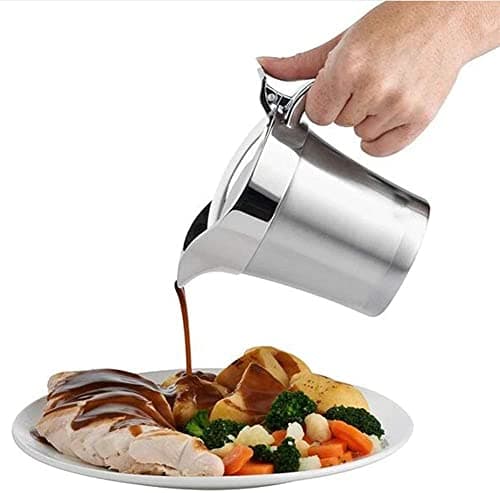 Double-Insulated Stainless Gravy Boat with Hinged Lid, 16 ozDouble-walled with a hinged lid — still hot at seconds. | Best overall | 9.2 | $16.99 · View on Amazon #ad We may earn a commission · Price as of October 4, 2026 |
| 2 | 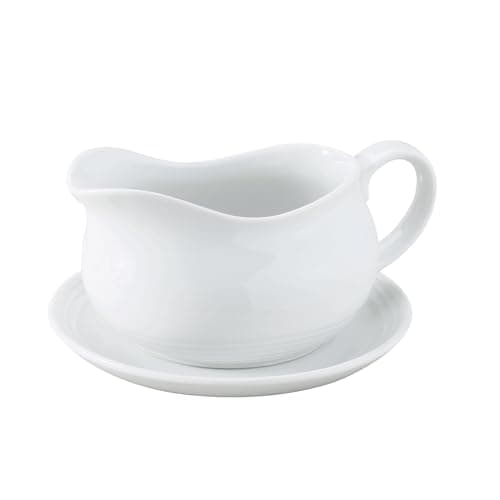 HIC Kitchen Hotel Gravy Boat, 24 oz24 ounces, which is close to double the usual. | Best for a crowd | 8.6 | $24.99 · View on Amazon #ad We may earn a commission · Price as of October 4, 2026 |
| 3 | 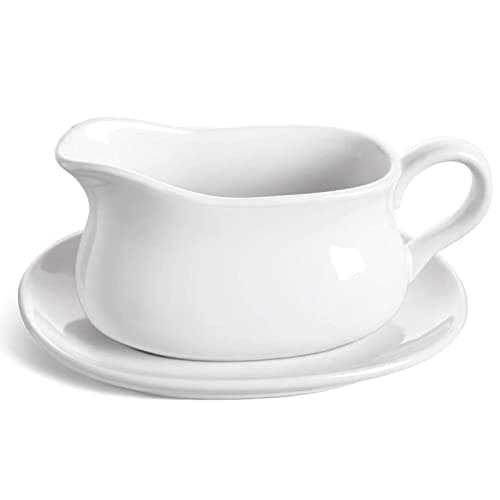 LE TAUCI Gravy Boat with Saucer, 17 oz17 ounces with a saucer to catch the drip. | Best for most tables | 8.4 | $22.99 · View on Amazon #ad We may earn a commission · Price as of October 4, 2026 |
Scores are our own editorial rubric, explained on how we pick. Four criteria per category, scored out of ten, so the leading pick is clear at a glance.
The actual problem with gravy boats
It is not capacity and it is not pouring. It is that gravy is the hottest thing on the table when it arrives and among the coldest by the time anybody wants more.
The physics are unkind. A gravy boat is a thin-walled vessel with a wide open top holding a small volume of liquid — a lot of surface area relative to mass, which is the recipe for rapid heat loss. Ceramic conducts it away, the open surface radiates and evaporates, and a small quantity has little thermal mass to lose.
There are only three real fixes: insulate it, cover it, or pre-warm it. A double-walled boat with a lid does the first two, which is why it leads this page despite not being the prettiest option.
How we picked
Our basis for recommendation is on how we pick. The criteria here are deliberately weighted toward the failure people actually complain about:
- Heat retention. Weighted heaviest. Double wall and a lid beat everything else.
- Capacity against guest count. Around 2 ounces per person on the first pour, with refills expected.
- Whether it pours without dribbling. A lip that runs is a stain on new linen.
- Whether it can be pre-warmed. Stoneware and porcelain can go in a low oven; check before you try it with anything else.
- Whether you would use it in March. The good ones do cream, custard and sauces all year.
What size gravy boat for how many people
Budget about 2 ounces per person for the first pour and assume a good proportion of the table comes back for more.
- Four to six people: 12 to 16 oz is plenty.
- Eight to ten people: 17 to 20 oz. This is the standard family-table size and where most boats sit.
- Twelve or more: 24 oz, or two smaller boats.
For a long table, two boats genuinely beat one large one. Gravy that has to travel the length of a table of fourteen arrives cold and interrupts three conversations on the way. One at each end solves both problems, and a second boat costs less than the annoyance.
Three ways to keep gravy hot that cost nothing
Whatever boat you own, these help, and the first one helps most:
- Pre-warm the boat. Fill it with boiling water while you finish the gravy, then tip it out and fill it. A cold ceramic boat steals a surprising amount of heat from a small volume of liquid in the first minute. This single step is worth more than any other trick here.
- Keep the bulk of it back. Hold the main pan of gravy on the stove on low or in a slow cooker on Warm, and send a part-filled boat to the table. Refill it hot rather than serving it all at once and letting it all go cold together.
- Cover it. Even a saucer laid over the top between pours makes a measurable difference. A lid is better, which is the argument for the insulated pick.
Hold the reserve at or above 140F, per published USDA guidance, the same as any other hot food on a long meal. More on that in how to keep food warm for a party.
Where it sits on the table
A gravy boat is one of the items that makes a holiday table crowded, because it needs a footprint and it has to be reachable without anybody standing up.
Put it near the carved turkey rather than in the center, because that is where it gets used. If you are running two boats, one at each end. And keep it off the decorative runner — a gravy lip dribbles eventually, and a saucer or small plate underneath is cheap insurance on linen you just bought.
Planning the whole surface, including what has to come off it to make room, is covered on how to set a Thanksgiving table.
Every pick, in detail
#ad We may earn a commission · Price as of October 4, 2026
#1 · Best overall
Double-Insulated Stainless Gravy Boat with Hinged Lid, 16 oz
The only kind of gravy boat that answers the actual complaint about gravy boats: a double wall and a hinged lid, so it is still hot when somebody asks for seconds.
Every other consideration with a gravy boat is secondary to one fact: gravy is served at the start of a meal and wanted again twenty minutes later, and an open porcelain boat is cold by then. A single-walled vessel with a large open surface is close to the worst possible shape for holding heat.
A double wall and a lid change the arithmetic. This style holds usable temperature for around an hour, which covers the whole meal including seconds. The hinged lid is the detail that makes it work in practice — you pour without removing it, so it is closed almost all the time, and there is never a hot wet lid looking for somewhere to sit on your tablecloth.
The honest cost is appearance. Stainless with a plastic handle does not look like heirloom porcelain, and on a formally set table that may matter to you. If it does, buy the porcelain below and accept that you will be reheating the gravy once.
- Capacity
- 16 oz
- Wall
- Double, insulated
- Lid
- Hinged, stays up to refill
- Material
- 304 stainless steel
What’s good
- Double wall holds temperature for about an hour
- Hinged lid pours without being taken off and put somewhere
- Stainless, so it will not chip like porcelain
- Sixteen ounces, which is a table's worth of gravy
What’s not
- Stainless and plastic looks less formal than porcelain
- Hinge is a moving part on a dishwasher item
- You cannot see how much is left
Heat retention
9.8
Capacity
8.8
Pouring
9.2
Value
8.8
#ad We may earn a commission · Price as of October 4, 2026
#2 · Best for a crowd
HIC Kitchen Hotel Gravy Boat, 24 oz
Twenty-four ounces, which is close to double the usual, and the reason a table of twelve does not need the boat refilled twice mid-meal.
- Capacity
- 24 oz
- Material
- Fine porcelain
- Safety
- Lead-free and cadmium-free
- Care
- Dishwasher safe
What’s good
- 24 oz — a table of twelve does not need it refilled twice
- Fine porcelain, lead-free and cadmium-free
- Classic hotelware shape that suits a formal table
- Dishwasher safe and holds up to repeated cycles
What’s not
- No lid, so it loses heat quickly
- Porcelain chips if it is knocked
- Large, and it takes real space on a crowded table
Heat retention
6.4
Capacity
9.8
Pouring
9.0
Value
9.0
#ad We may earn a commission · Price as of October 4, 2026
#3 · Best for most tables
LE TAUCI Gravy Boat with Saucer, 17 oz
Seventeen ounces covers a normal family, and the matching saucer catches the drip that otherwise ends up on a tablecloth you just bought.
- Capacity
- 17 oz
- Material
- Stoneware ceramic
- Includes
- Matching saucer
- Safe in
- Dishwasher, microwave, oven
What’s good
- 17 oz covers a normal family table
- Matching saucer catches drips off the lip
- Stoneware is oven, microwave and dishwasher safe
- Warming it in the oven first genuinely helps
What’s not
- No lid
- The saucer is one more thing on a full table
- Stoneware is heavier than porcelain when full
Heat retention
7.0
Capacity
8.4
Pouring
8.8
Value
9.2
Frequently asked questions
Allow about 2 ounces per person for the first pour and expect refills. That makes 12 to 16 oz right for four to six people, 17 to 20 oz for a family table of eight to ten, and 24 oz or two boats for twelve or more.
Pre-warm the boat with boiling water before filling it, keep the bulk of the gravy hot on the stove or in a slow cooker on Warm and refill in small amounts, and cover the boat between pours. An insulated double-walled boat with a lid does most of this for you and holds temperature for about an hour.
Yes, if hot gravy at seconds matters to you — a lid plus a double wall is the only reliable fix for the heat loss that makes gravy boats frustrating. The trade is appearance: insulated models are stainless rather than porcelain and look less formal on a dressed table.
Stoneware and porcelain models labelled oven safe can go in a low oven, and it makes a real difference. Check the manufacturer’s guidance first, and never do it with an insulated stainless boat or anything with plastic parts. Filling it with boiling water and tipping it out achieves most of the same thing with no risk.
Sources
Related reading
- The Best Serving Platters for a Holiday TablePlatters sized for a real carved turkey, plus the charger-plate trick that makes mismatched dinnerware look deliberate.
- How to Keep Food Warm for a PartyEight methods ranked, with the 140F safety floor explained and the dishes that simply will not hold.
- How to Carve a TurkeySix steps, in order, plus the resting rule and the warm-platter trick that keeps it hot.
- How to Set a Thanksgiving TableWhere each piece goes, how much space each guest needs, and the seating math for squeezing in twelve.
- The Thanksgiving Hosting ChecklistTwo weeks to zero hour, day by day — with the thaw math and the final hour broken down minute by minute.